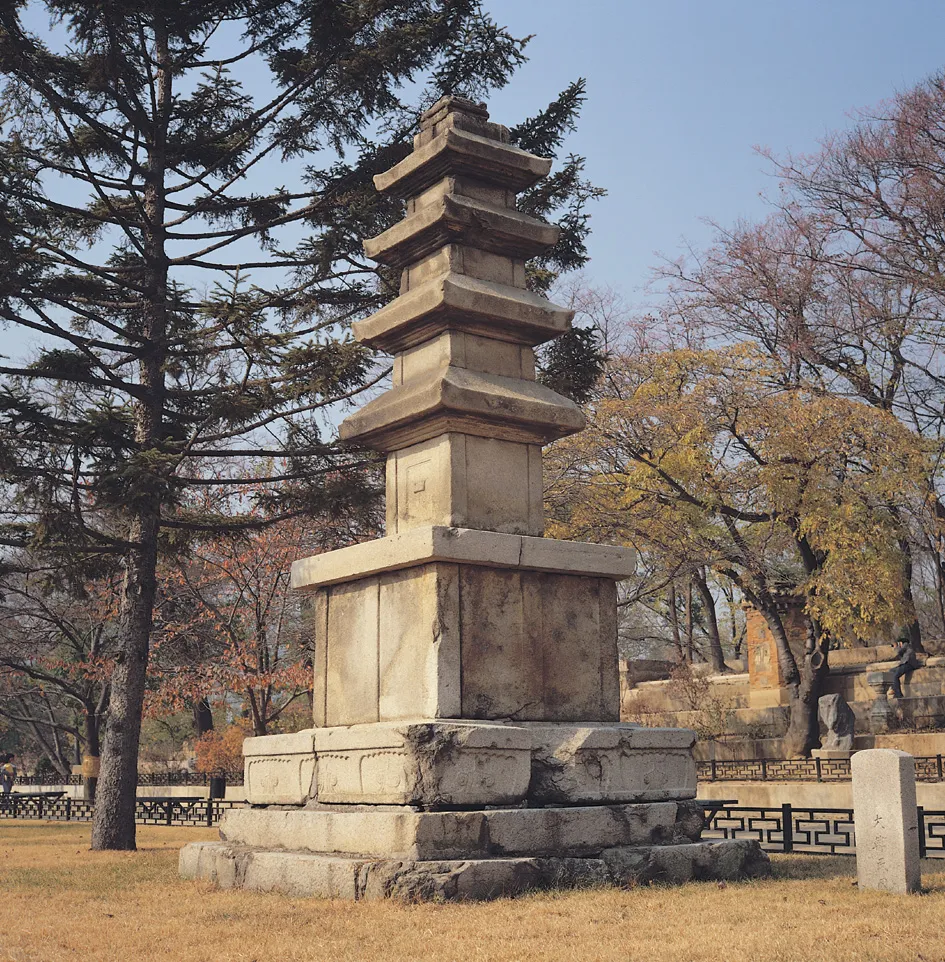
Five-story Stone Pagoda from Jeongdosa Temple Site, Chilgok
漆谷 淨兜寺址 五層石塔
대구광역시 수성구
Basic information
- Designation
- Treasure No.357
- Category
- Sites & Pagodas
- Era
- 고려 현종 22년(1031)
- Designated year
- 1963
- Location
- 수성구, 대구광역시— 대구광역시 수성구 청호로 321 (황금동, 국립대구박물관)
- Coordinates
- 35.845590, 128.638387
AI Docent
Coming soonAn AI-generated, friendly retelling of this heritage site is available in Korean. An English version is on our roadmap — for now, please see the official description below.
Description
Originally located at Jeongdosa Temple site in Chilgok-gun, Gyeongsangbuk-do, this pagoda was moved to Gyeongbokgung Palace in 1924 and moved again to Daegu National Museum in 1994. During the move, the motive and history of pagoda construction were fortuitously discovered, so it became clear when it was built. It stands on a two-story stylobate. The lower stylobate was engraved with three symbolic images of the elephant’s eyes on each side. The bottom lines of the patterns rise up inside like a flower. A pillar pattern was engraved in the middle of each side of the upper stylobate. An unusual feature is a single-tiered support above the capstones, which forms a gentle slope. The main stones and the roof stones of the body of the pagoda were each made of a single stone. The main stone of the first story was engraved with a door-shaped design with a lock-shaped design inside, while from the second upwards the stories get smaller. It is typical of the Goryeo Dynasty style that the capstone, narrow but thick, has an upward curving edge at the eaves. The base supporting the roof is reduced to four tiers. Holes for raindrops are engraved on the bottom of the eaves. The roof stone of the fifth floor has gone, and only the final base on the main stone remains. Although the main stones from the second floor up do not gradually diminish in size and the roof stones have a narrow, thick appearance, the surface of the pagoda has not been ruined. In addition, the symbolic images of the elephant’s eyes are clearly and beautifully engraved. The name of the pagoda is engraved on the upper stylobate along with the year of its construction, "The Eleventh Year of Taepyeong (Great Peace)". When it was being moved, sarira relinquary of a blue oil sarira bottle and two bronze chests were found in the pagoda. On a document that was also found, the history of the pagoda and facts about its construction are recorded. This is important material for study of Idu script as well as pagoda itself, since Idu script was used a lot in this document. "The Eleventh Year of Taepyeong" corresponds to the 22nd year of the reign of King Hyeonjong (1031) of Goryeo.
Location
지도를 불러오는 중…
Have you visited this place?
Log in and verify your visit on-site via GPS to record a stamp in My Journey. (QR verification coming later.)
Images: KOGL (khs.go.kr) · Data source: Korea Heritage Service Open API (khs.go.kr)