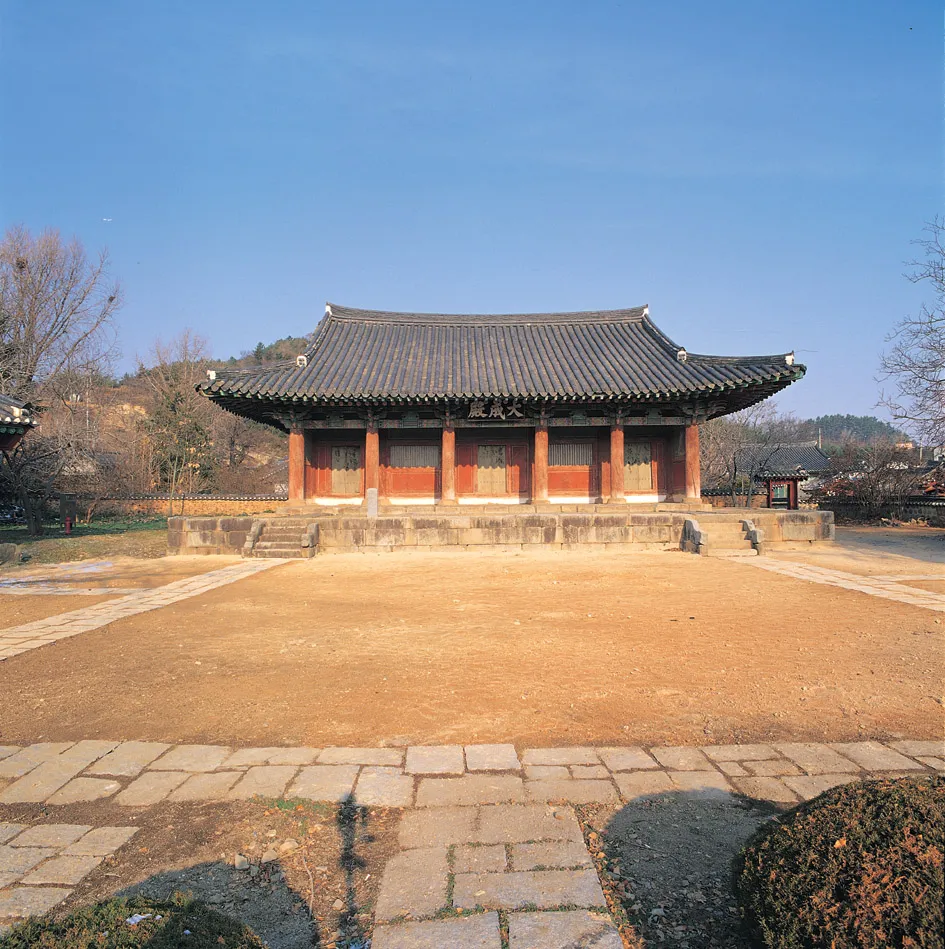
Daeseongjeon Shrine of Najuhyanggyo Local Confucian School
羅州鄕校 大成殿
전라남도 나주시
Basic information
- Designation
- Treasure No.394
- Category
- Architecture
- Era
- 조선시대 중기
- Designated year
- 1963
- Location
- 나주시, 전라남도— 전라남도 나주시 향교길 38(교동, 나주향교)
- Coordinates
- 35.033341, 126.711377
AI Docent
Coming soonAn AI-generated, friendly retelling of this heritage site is available in Korean. An English version is on our roadmap — for now, please see the official description below.
Description
A hyanggyo is a local Confucian school established by the government to provide education and to hold memorial ceremonies for Confucius and other sages. Najuhyanggyo Local Confucian School was established in the 7th year of the reign of King Taejong (1407). However, since the modern school system was introduced, it has only performed memorial services. The Daeseongjeon Shrine is the place where memorial services were held and is generally located at a higher location than the Myeongnyundang Hall, the education hall, but Najuhyanggyo has a Gyeseongsa Shrine in which to perform services for the father of Confucius, and in this case, the locations of the two halls are switched. With five kan (a unit of measurement referring to the distance between two columns) in the front and four kan at the side, the building has a hip and gable roof called paljakjibung. The decorated column-heads made to support the weight of the roof rest only on the pillars. This is called jusimpo style. Partly however, the building also uses the wing construction technique in which a base is built between the pillars, which means that it was constructed in an eclectic way. The inside of building is floored, and the ceiling is made up to leave the frame visible. With its detailed technique and large scale, this is a good example of the typical style of Daeseongjeon Shrine in mid Joseon, and along with Munmyo Confucian Shrine in Seoul, and Gangneunghyanggyo and Jangsuhyanggyo Local Confucian Schools, it is an important cultural asset.
Location
지도를 불러오는 중…
Have you visited this place?
Log in and verify your visit on-site via GPS to record a stamp in My Journey. (QR verification coming later.)
Images: KOGL (khs.go.kr) · Data source: Korea Heritage Service Open API (khs.go.kr)