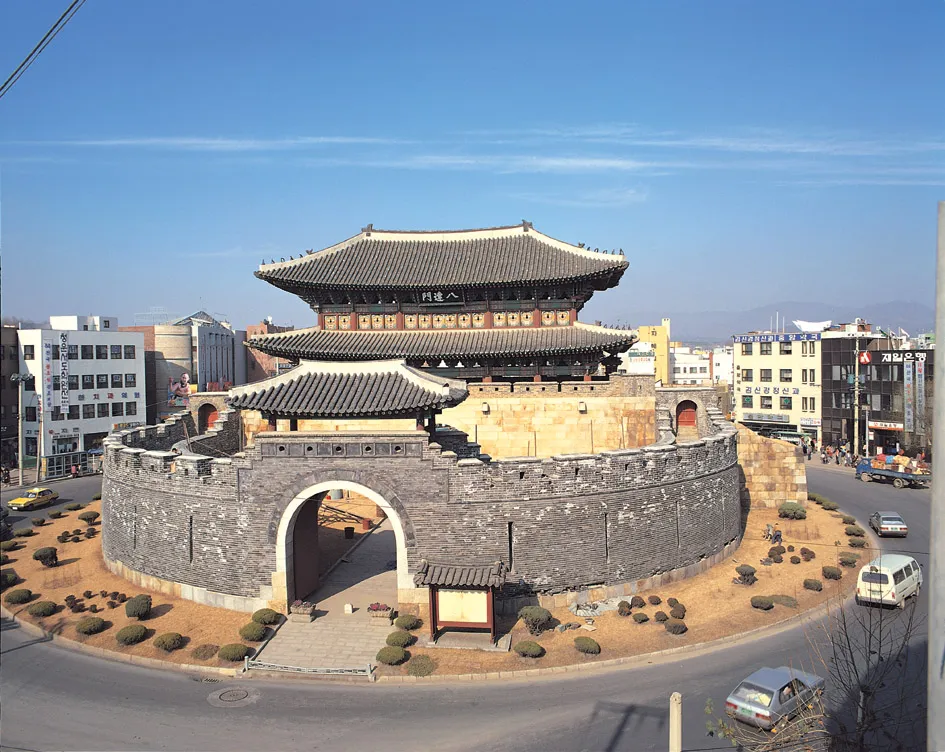
Paldalmun Gate, Suwon
水原 八達門
경기도 수원시
Basic information
- Designation
- Treasure No.402
- Category
- Architecture
- Era
- 조선 정조 20년(1796)
- Designated year
- 1964
- Location
- 수원시, 경기도— 경기 수원시 팔달구 팔달로2가 138번지
- Coordinates
- 37.277558, 127.016737
AI Docent
Coming soonAn AI-generated, friendly retelling of this heritage site is available in Korean. An English version is on our roadmap — for now, please see the official description below.
Description
The construction of Suwonseong Fortress started in 1794, the 18th year of the reign of King Jeongjo when the royal mausoleum of Prince Sado, father of King Jeongjo, was moved from Yangju to Suwon. It was completed two years later. The style of its architecture was borrowed from that of Chinese fortress walls, but because it was built in a scientific way, it is more advanced. It is an outstanding cultural asset representing the Korean fortress. This is the south gate of Suwonseong Fortress and took its name from Paldalsan Mountain. The gate tower is a two-story building composed of five kan (a unit of measurement referring to the distance between two columns) in the front and two kan at the side. The roof with four sides is an ujingakjibung (hipped roof), showing a trapezoid shape when looked at from the front. It has a multi-cluster bracket style, where gongpo, or column-heads, designed to support the eaves of the roof on the pillars, are set up not only on the pillars but also between them, typical of the style of later Joseon. On the outer side, the barbican was built in a semicircular shape to protect and guard the gate. The gate was restored when the fortress was rebuilt in its original shape in 1975. Originally, it was linked with the fortress walls on both sides but since the road around it was built, only the gate now remains. This is the largest and most spectacular among the buildings of Suwonseong Fortress, and is highly regarded as a cultural asset because it embodies various architectural styles of fortress gates of later Joseon.
Location
지도를 불러오는 중…
Have you visited this place?
Log in and verify your visit on-site via GPS to record a stamp in My Journey. (QR verification coming later.)
Images: KOGL (khs.go.kr) · Data source: Korea Heritage Service Open API (khs.go.kr)