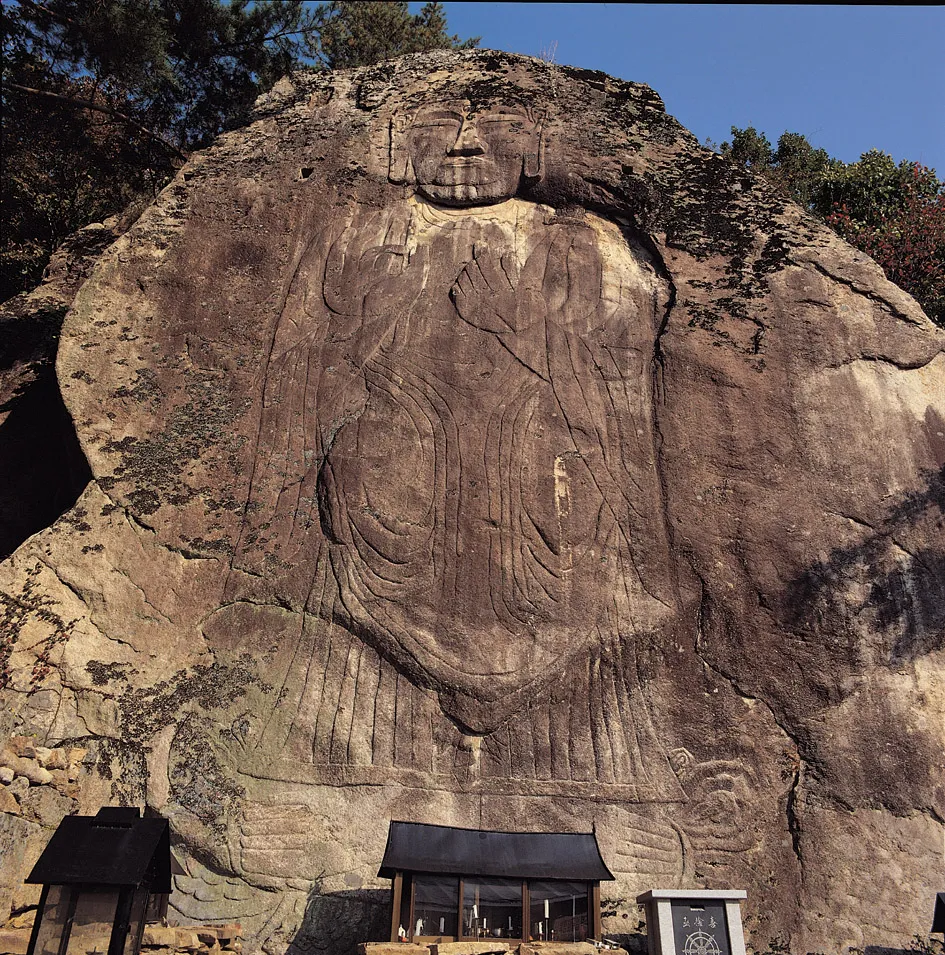
Rock-carved Standing Buddha of Deokjusa Temple, Jecheon
堤川 德周寺 磨崖如來立像
충청북도 제천시
Basic information
- Designation
- Treasure No.406
- Category
- Sculpture
- Era
- 고려시대
- Designated year
- 1964
- Location
- 제천시, 충청북도— 충북 제천시 한수면 송계리 1번지 덕주사
- Coordinates
- 36.869829, 128.104908
AI Docent
Coming soonAn AI-generated, friendly retelling of this heritage site is available in Korean. An English version is on our roadmap — for now, please see the official description below.
Description
This Buddha statue is carved on the east stone wall of Deokjusa Temple located on the middle of Woraksan Mountain in Jecheon. According to Donggungnyeojiseungnam (Augmented Survey of the Geography of Korea), the temple was built by Princess Deokju, the older sister of Silla's Crown Prince Maui. It was burned down and destroyed during the Korean War and all that remains are the temple grounds. The large statue, carved on the southern part of the granite wall, is 13 meters in height. The face is carved so as to stick out while the body is carved in lines only. On the flat head is a semicircular usnisa (a protuberance symbolizing supreme wisdom). It has a chubby face with elongated eyes, a large nose, and an emphatic hanging chin. This kind of exaggeration can be seen commonly in large Buddha statues from the Goryeo Dynasty. The neck is almost non-existent so that the head is basically just sitting on the body. Samdo, i.e. the three wrinkles that are supposed to be on the neck are instead carved on the upper part of the body. The body is only depicted as lines, ignoring the shape of the body, and looks strange. The beobeui (sacerdotal robe) around the shoulders hangs weakly and the folds in the clothing also lack vividness. The right hand is held up to the chest with the thumb and middle finger together, and the back of the left hand is showing. The feet are spread to the sides and are almost too big, with long, thick toes. They are supported by pedestals in the form of lotus flowers. This statue was made during the early Goryeo Dynasty, possibly in the eleventh century when the making of such large Buddha statues was becoming popular. The carving method used for the chubby face and the simple, two-dimensional body makes the statue seem rather awkward in comparison to its size.
Location
지도를 불러오는 중…
Have you visited this place?
Log in and verify your visit on-site via GPS to record a stamp in My Journey. (QR verification coming later.)
Images: KOGL (khs.go.kr) · Data source: Korea Heritage Service Open API (khs.go.kr)