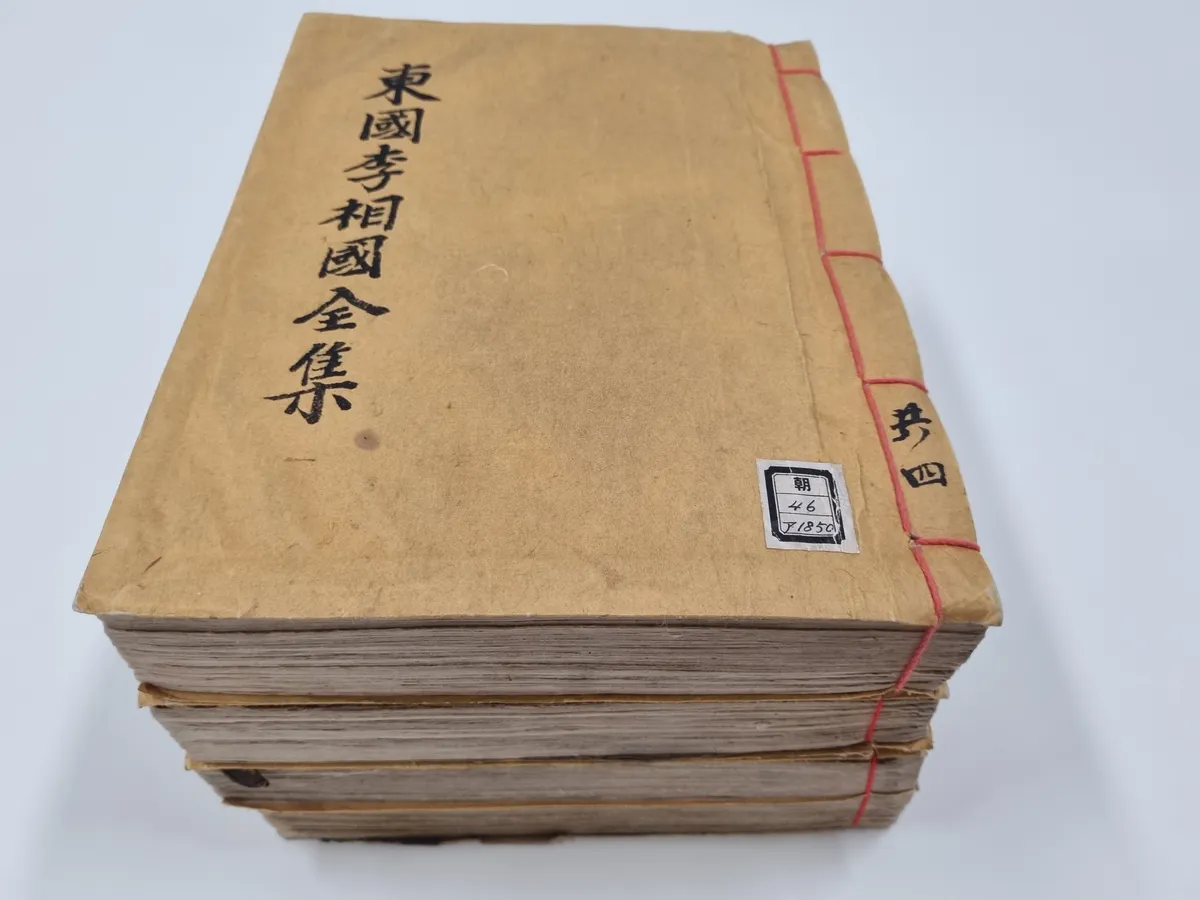
Donggugisanggukjeonjip Gwon18∼22, 31∼41
東國李相國全集 卷十八∼二十二, 三十一∼四十一
서울특별시 서초구
Basic information
- Designation
- Treasure No.2282
- Category
- Books & Records
- Era
- 1251년(고려 고종 38) 판각, 고려 말 후인
- Designated year
- 2025
- Location
- 서초구, 서울특별시— 서울특별시 서초구 반포대로 201(반포동, 국립중앙도서관)
- Coordinates
- 37.497423, 127.003228Kakao address conversion
AI Docent
Coming soonAn AI-generated, friendly retelling of this heritage site is available in Korean. An English version is on our roadmap — for now, please see the official description below.
Description
Machine-translatedThis English description was machine-translated and may contain inaccuracies. Refer to the original Korean text for details.
The Complete Works of Yi Kwi-bo comprises the collected writings of Yi Gwibo (1168-1241), distinguished scholar-official of the mid-Goryeo period. Yi Gwibo's son Yi Ham initially compiled the collection, and following Yi Gwibo's death in August 1241, his compiler Jin Yang-gong (Count of Jinan) Choe Yi oversaw publication expansion into a 41-volume complete edition. Subsequent supplementary compilations addressed omitted poetry and prose, creating a 12-volume continuation collection completed in December 1241, including biographical records and tomb epitaphs. However, the edition contained numerous errors and lacunae. Accordingly, in 1251, during the reign of King Gojong, Yi Gikbae, Yi Gwibo's great-grandson, who served as County Administrator of Hadong, submitted revised proofing undertaken at the Buddhist Tripitaka woodblock carving bureau upon completion of the Tripitaka project. This edition includes a postscript and publication record authored by Yi Gikbae documenting the Buddhist bureau's imperial mandate authorization for woodblock carving and identifying the collation scholars including Jang Sehou, Jeong Hongsik, and Jeon Gwangjae. The National Central Library's Complete Works of Yi Kwi-bo preserves only volumes 18-22 and 31-41 (sixteen volumes across four fascicles) representing fragmentary copies, yet constitutes the oldest and rarest presently extant edition. Furthermore, among Korean repositories, the present copy features the greatest quantity and superior print quality. As a personal literary collection compiled and published during the Goryeo period, when Buddhist textual compilation and printing dominated cultural production, this work possesses distinctive rarity and constitutes exceptionally important bibliographic documentation.
Location
지도를 불러오는 중…
Have you visited this place?
Log in and verify your visit on-site via GPS to record a stamp in My Journey. (QR verification coming later.)
Images: KOGL (khs.go.kr) · Data source: Korea Heritage Service Open API (khs.go.kr)