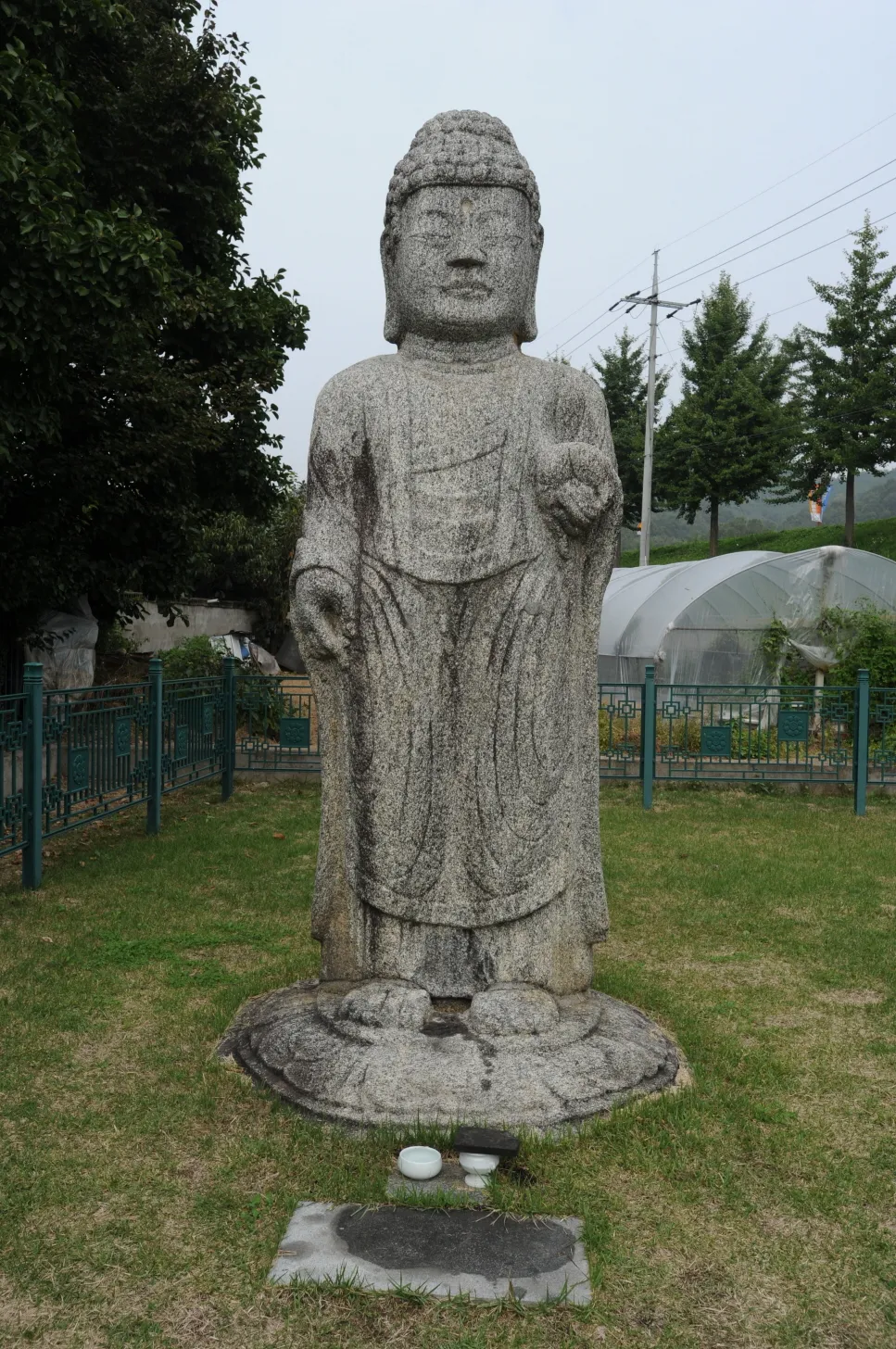
Stone Standing Buddha in Dongbon-ri, Yecheon
醴泉 東本里 石造如來立像
경상북도 예천군
Basic information
- Designation
- Treasure No.427
- Category
- Sculpture
- Era
- 통일신라시대
- Designated year
- 1965
- Location
- 예천군, 경상북도— 경북 예천군 예천읍 동본리 474-4번지
- Coordinates
- 36.659020, 128.461708
AI Docent
Coming soonAn AI-generated, friendly retelling of this heritage site is available in Korean. An English version is on our roadmap — for now, please see the official description below.
Description
This 3.46-meter-high three-story Stone Pagoda dating from the late Unified Silla Period is located in Dongbon-dong of Yecheon, Gyeongsangbuk-do, along with a three-story stone pagoda (Treasure No. 426). The Buddha’s hair is expressed in the small curly nabal style (i.e. twirled up and around in a seashell-shaped fashion), and a large usnisa (a protuberance symbolizing supreme wisdom) can be seen on top of his head. The smooth-looking face has wide eyes, a short nose, and a wide mouth that are carved in gentle lines, conveying the merciful and mild smile of the Buddha well. The body is small compared to the large face, and the short thick neck, narrow shoulders, short arms and flat chest are less manly looking than other statues. His right arm hangs down close to the body, while his right hand holds the clothes slightly. His left hand is raised, with all the fingers except the little finger flexed inwardly. The beobui (sacerdotal robes) covering both shoulders flows in two directions (Y-shaped) around his thighs, creating oval-shaped folds around both legs. The dull and schematic expression of the folds is typical of Buddha statues of the 8th century, thus giving a fairly clear idea of the statue’s production date. Judging from the long oval folds around the legs, the dull body lacking in volume, and smooth-looking face, this Buddha statue follows the style of Buddha statues made during the eighth century in the Unified Silla Period, although it also exhibits elements originating from the period of transition to the Goryeo Dynasty.
Location
지도를 불러오는 중…
Have you visited this place?
Log in and verify your visit on-site via GPS to record a stamp in My Journey. (QR verification coming later.)
Images: KOGL (khs.go.kr) · Data source: Korea Heritage Service Open API (khs.go.kr)