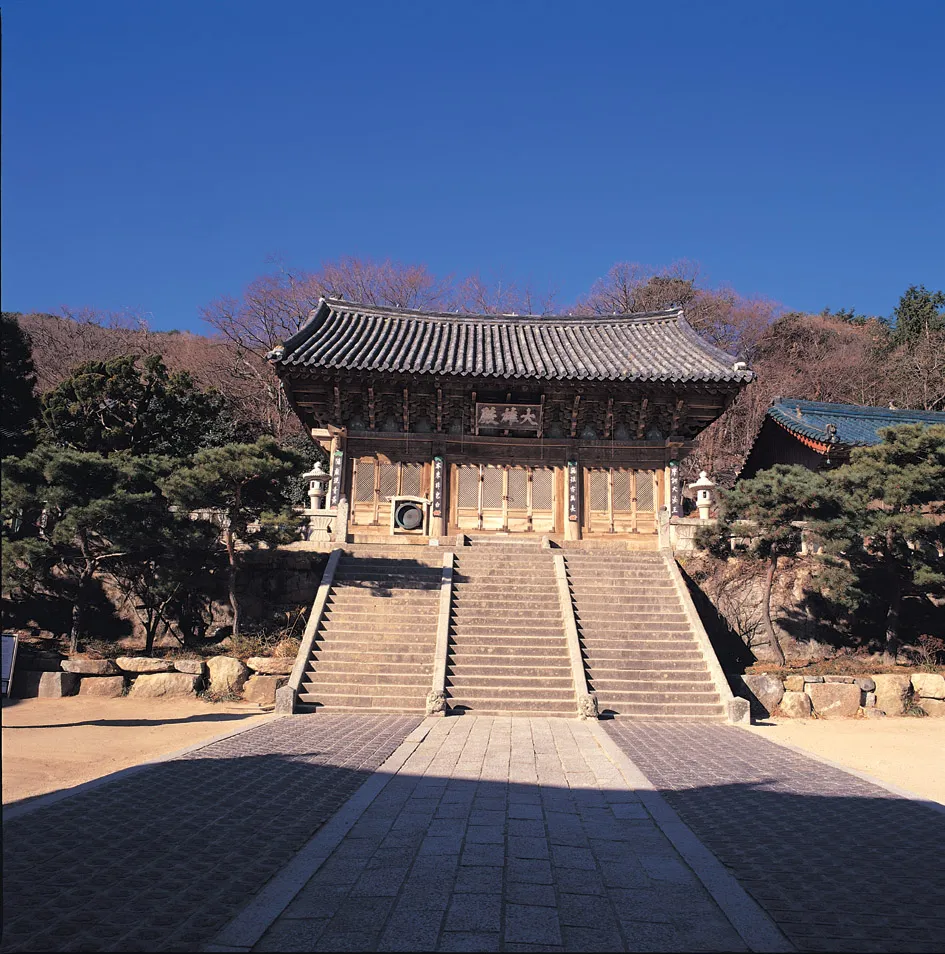
Daeungjeon Hall of Beomeosa Temple, Busan
釜山 梵魚寺 大雄殿
부산광역시 금정구
Basic information
- Designation
- Treasure No.434
- Category
- Architecture
- Era
- 조선시대 중기
- Designated year
- 1966
- Location
- 금정구, 부산광역시— 부산 금정구 범어사로 250, 범어사 (청룡동)
- Coordinates
- 35.283934, 129.068144
AI Docent
Coming soonAn AI-generated, friendly retelling of this heritage site is available in Korean. An English version is on our roadmap — for now, please see the official description below.
Description
Unlike other Daeungjeon halls in which Sakyamuni statues are enshrined, Daeungjeon Hall at Beomeosa Temple* enshrines a Sakyamuni statue, flanked by statues of Maitreya (Maitreya Bodhisattva) and Gara Bodhisattva. This Daeungjeong Hall was burnt down during the Japanese Invasion of Korea in 1592, but was rebuilt in 1602 (the 35th year of the reign of King Seonjo of the Joseon Dynasty) and repaired again in 1631 (the 5th year of the reign of Prince Gwanghae of Joseon). The building measures three kan (a unit of measurement referring to the distance between two columns) at the front and three kan at the sides, and has a gable roof resembling the character 人. The eaves of the roof are supported by a system of brackets placed on and between the pillars. In addition, the interior altar in which a Buddhist statue is placed, and the roof-shaped canopy decorating the altar display the delicate and refined carving style of Buddhist architecture and the woodcraft of the Joseon Dynasty. * According to Ilyeon's Samguk yusa (Memorabilia of the Three Kingdoms), Beomeosa Temple, one of the three renowned temples of Gyeongsangnam-do (the southeastern part of Korea), was built in 678 (the 18th year of the reign of King Munmu) by Uisang, the greatest Buddhist figure of the Unified Silla Period. It is also known as an important temple site where monks stayed and participated in the war during the Japanese Invasion of Korea in 1592-98. It is also known as an important temple site that the temple’s monks participated in fighting against the Japanese during the Japanese Invasion of Korea in 1592-98.
Location
지도를 불러오는 중…
Have you visited this place?
Log in and verify your visit on-site via GPS to record a stamp in My Journey. (QR verification coming later.)
Images: KOGL (khs.go.kr) · Data source: Korea Heritage Service Open API (khs.go.kr)