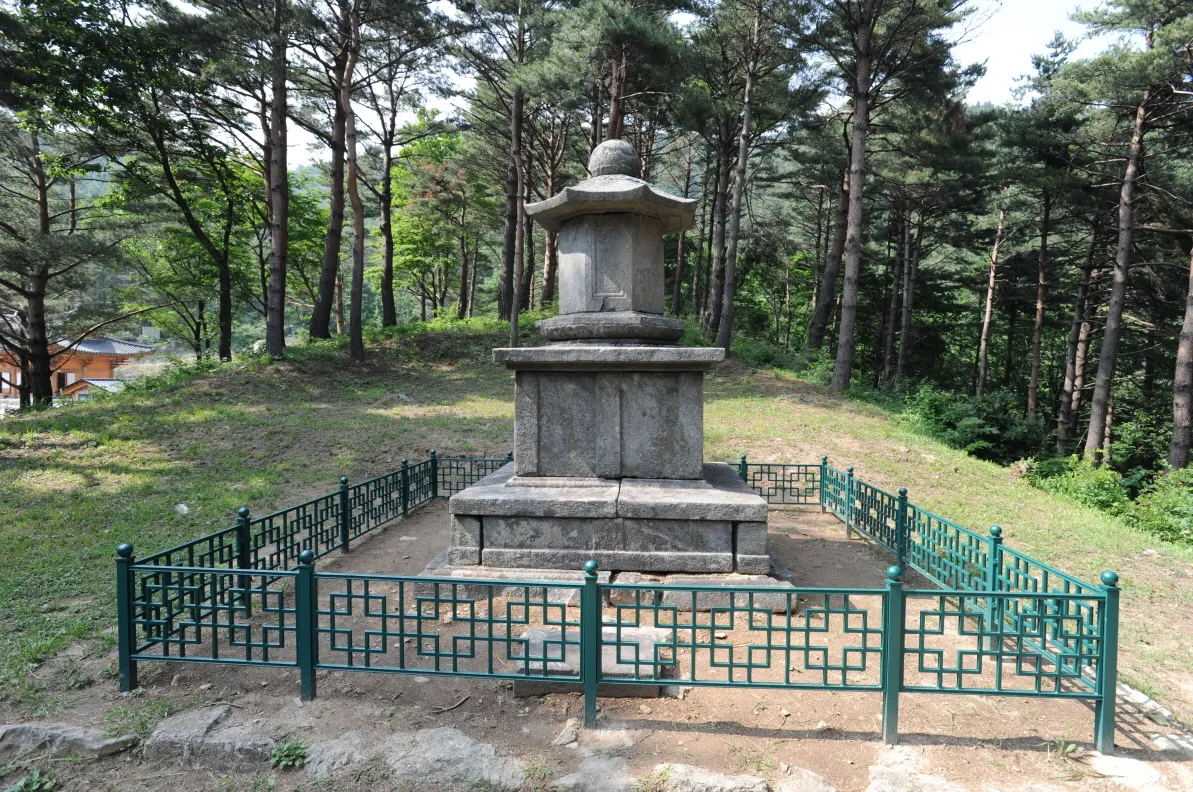
Stupa of Master Doui at Jinjeonsa Temple Site, Yangyang
襄陽 陳田寺址 道義禪師塔
강원특별자치도 양양군
Basic information
- Designation
- Treasure No.439
- Category
- Sites & Pagodas
- Era
- 통일신라시대
- Designated year
- 1966
- Location
- 양양군, 강원특별자치도— 강원 양양군 강현면 둔전리 산1번지
- Coordinates
- 38.122669, 128.546050
AI Docent
Coming soonAn AI-generated, friendly retelling of this heritage site is available in Korean. An English version is on our roadmap — for now, please see the official description below.
Description
This stupa stands on a small hill overlooking the distant East Sea at the site of Jinjeonsa Temple. It is assumed that the stupa contained the sarira of Zen Master Doui, the monk responsible for the construction of Jinjeonsa Temple. Doui was initiated to Zen Buddhism in Tang China in 784 (the 5th year of the reign of King Seongdeok of the Silla Dynasty), and, upon his return to Silla in 821, he tried to introduce it to Korea. However, as many people were devoted exclusively to the Gyo Order at that time, he moved to the temple and led an ascetic life there for the last 40 years of his life. Unlike other stupas, it consists of an octagonal main body and a two-layered square stylobate, which are actually typical features of stone pagodas. The center and corners of all the surfaces of the stylobate are carved with pillar patterns, while the sides of the stone supporting the main body are engraved with a lotus flower design. The main body, shaped like a tile-roofed house, is unadorned except for the door pattern carved on one side. The eaves are almost horizontal; and the roof stone slopes gently along the outer surface of the roof, and curves smoothly along the edges of the eaves. This atypical stupa features a stylobate that resembles those of stone pagodas. This stupa of Master Doui, which may be considered a starting point for the construction of Korean stone pagodas, is believed to have been built in the 9th century. Overall, it has a neat tidy appearance characterized by well-trimmed stone materials and a simple restrained carving style.
Location
지도를 불러오는 중…
Have you visited this place?
Log in and verify your visit on-site via GPS to record a stamp in My Journey. (QR verification coming later.)
Images: KOGL (khs.go.kr) · Data source: Korea Heritage Service Open API (khs.go.kr)