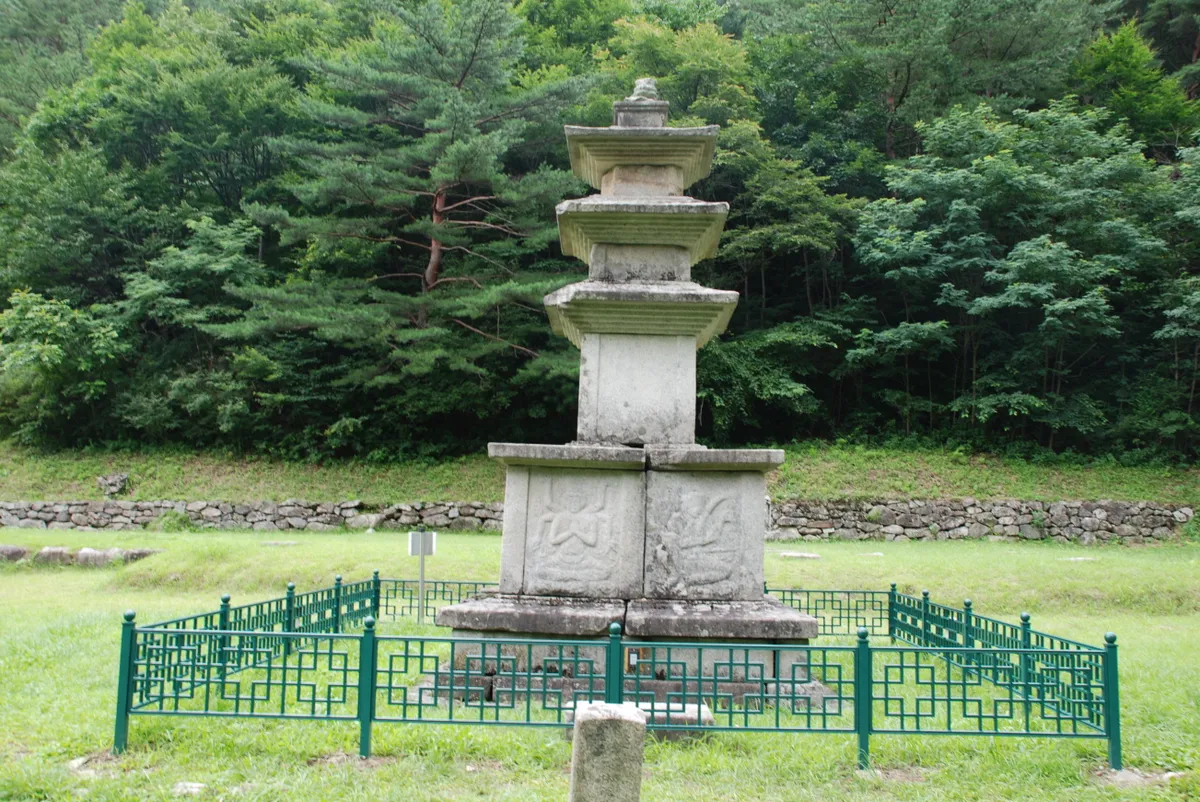
Three-story Stone Pagoda at Seollimwon Temple Site, Yangyang
襄陽 禪林院址 三層石塔
강원특별자치도 양양군
Basic information
- Designation
- Treasure No.444
- Category
- Sites & Pagodas
- Era
- 통일신라시대
- Designated year
- 1966
- Location
- 양양군, 강원특별자치도— 강원 양양군 서면 황이리 424번지
- Coordinates
- 37.944498, 128.516271
AI Docent
Coming soonAn AI-generated, friendly retelling of this heritage site is available in Korean. An English version is on our roadmap — for now, please see the official description below.
Description
This stone pagoda consisting of a three-story main body and a two-layered stylobate, i.e. the typical style of Silla stone pagodas, is located to the south of the site of the Buddhist sanctuary at the Seollimwon Temple site. Various important relics were discovered at the temple site in 1948, including a Buddhist temple bell bearing an inscription, a Stone Lantern (Treasure No. 445), the Stele for Master Honggak (Treasure No. 446), and a Stupa (Treasure No. 447). These relics were originally found in a dilapidated state and restored. The bottom layer of the pagoda’s stylobate rests on a foundation composed of several pieces of stone. On its bottom and upper layers, every corner and the center of each face are engraved with a pillar pattern. Each of the four facets of the upper layer is divided into two spaces, in each of which is engraved one of the Palbujungsang, i.e. the eight guardian deities of Buddhist law, in relief. Each core and roof stone of the main body is hewn from a single stone. The core stone of the first story is relatively tall, while that of the second story tapers in half. All the corners of each core stone are engraved with a pillar pattern. Each of the roof stones is wide and slopes sharply before turning swiftly upward at the four edges, and has a five-tiered cornice. Of the upper part of the pagoda, only the finial base, with a hole used to fix an iron rod, and the boju (finial), which doesn’t seem to be the original, remain. Although the pagoda is well-proportioned on the whole, the carving technique applied to the Palbujungsang seems unsophisticated, and the composition of the stone materials is out of the rule. Although this pagoda follows the general architectural style of Silla stone pagodas, judging from the structure of the stylobate and the carving styles applied to each part, it is assumed that this three-story stone pagoda was erected in the 9th century during the late Silla period. Prior to commencement of the restoration work, sixty miniature pagodas and a bronze prayer gong were discovered in the stylobate of the pagoda. A stone prayer platform carved with symbolic images of the elephant’s eyes has been preserved in front of the pagoda.
Location
지도를 불러오는 중…
Have you visited this place?
Log in and verify your visit on-site via GPS to record a stamp in My Journey. (QR verification coming later.)
Images: KOGL (khs.go.kr) · Data source: Korea Heritage Service Open API (khs.go.kr)