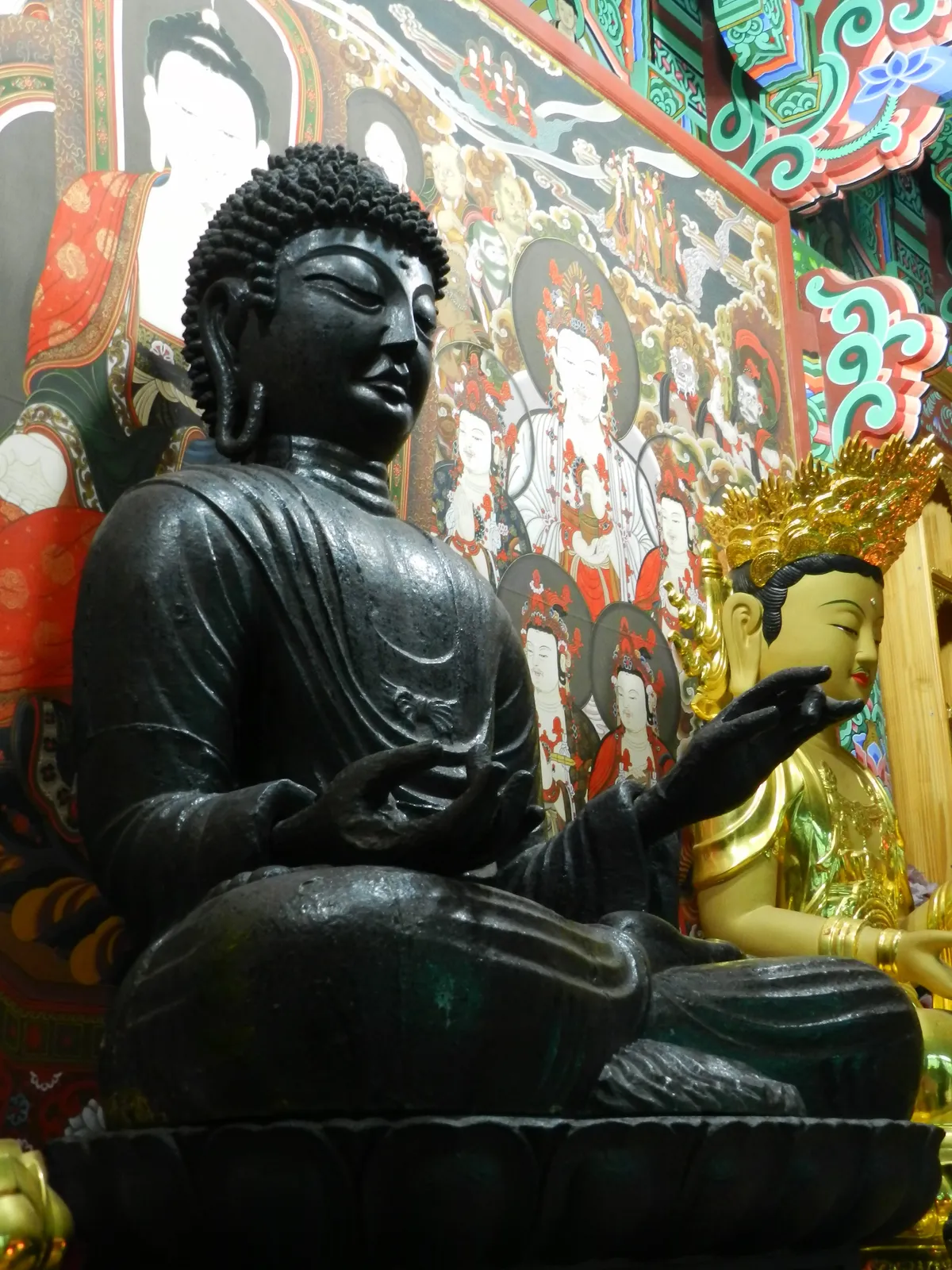
Iron Seated Buddha of Danhosa Temple, Chungju
忠州 丹湖寺 鐵造如來坐像
충청북도 충주시
Basic information
- Designation
- Treasure No.512
- Category
- Sculpture
- Era
- 고려시대
- Designated year
- 1969
- Location
- 충주시, 충청북도— 충청북도 충주시 직동길 271-56 (직동, 석종사)
- Coordinates
- 36.946743, 127.900860
AI Docent
Coming soonAn AI-generated, friendly retelling of this heritage site is available in Korean. An English version is on our roadmap — for now, please see the official description below.
Description
This iron seated Buddha is enshrined in the Daeungjeon Hall of Danhosa Temple in Chungju. Though the year of the temple’s construction is unknown, it was repaired, at that time called Yaksa Temple, during the reign of King Sukjong (r. 1674~1720) of the Joseon Dynasty, and then renamed Danhosa in 1954. A large usnisa (a protuberance symbolizing supreme wisdom) can be seen on top of the Buddha’s head, and in the middle of the head is a half-moon shape, a feature commonly found in Buddha statues made during the Goryeo Dynasty. The oval face, the eyes, nose, and mouth are all gracefully expressed. The ears are elongated, and the samdo, i.e. the three wrinkles on the neck, can be seen clearly. The Buddha’s beobui (sacerdotal robe), draped over both shoulders, gives a heavy impression. The folds in the garments are expressed simply in a few lines. The strap and knot depicted horizontally on the chest are similar to those on statues from the end of the Goryeo to the early Joseon Dynasty. The upper body is rectangular in shape with narrow, round shoulders and a flat chest. The legs have the knees laid flat with the soles of feet facing upwards. The horizontal wrinkles apparent on the knees are quite formal. The detailed expression of the face and the half-moon pattern above the forehead are characteristic of the Buddha statues made during the Goryeo Dynasty. In addition, the unusual expressions of the folds in the garments and of the angular upper body show that the statue also has particular regional characteristics.
Location
지도를 불러오는 중…
Have you visited this place?
Log in and verify your visit on-site via GPS to record a stamp in My Journey. (QR verification coming later.)
Images: KOGL (khs.go.kr) · Data source: Korea Heritage Service Open API (khs.go.kr)