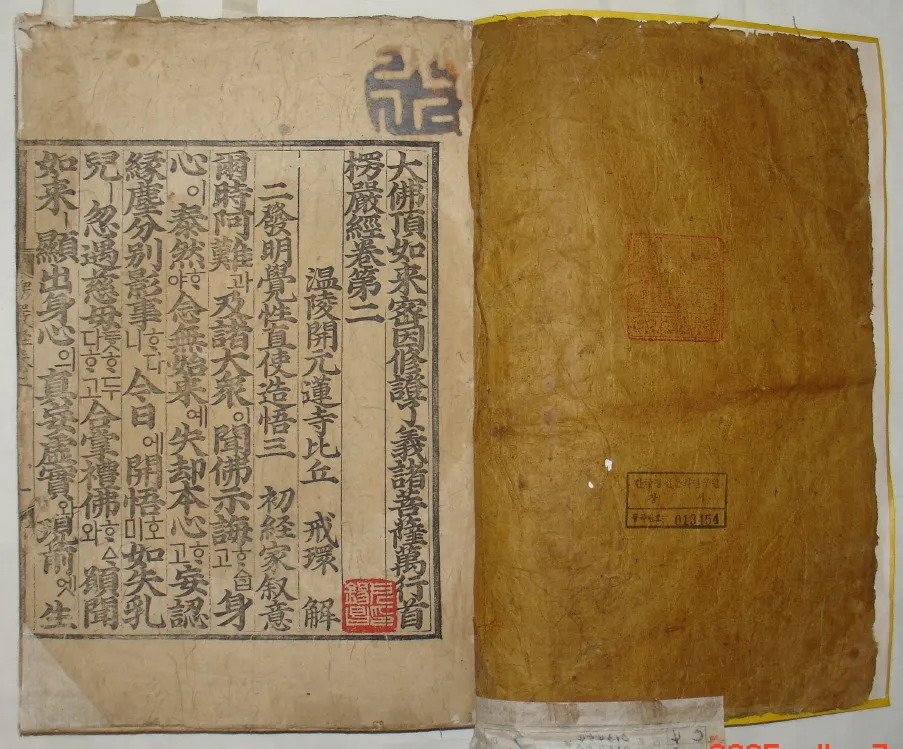
Daebuljeongyeoraemirinsujeungyouijebosalmanhaengsuneungeomgyeong Gwon2, 10
大佛頂如來密因修證了義諸菩薩萬行首楞嚴經 卷二, 十
경기도 성남시
Basic information
- Designation
- Treasure No.1515
- Category
- Books & Records
- Era
- 1462년(조선 세조 8년)
- Designated year
- 2007
- Location
- 성남시, 경기도— 경기도 성남시 분당구 하오개로 323 (운중동, 한국학중앙연구원)
- Coordinates
- 37.393030, 127.052183
AI Docent
Coming soonAn AI-generated, friendly retelling of this heritage site is available in Korean. An English version is on our roadmap — for now, please see the official description below.
Description
Consisting of 10 volumes, the major theme of Shurangama Sutra (The Sutra of the Heroic One) is the importance of practicing the Buddha's teachings to understand the Dharma. Shurangama Sutra, also known as White Umbrella Dharani, in the seventh volume, is daily recited in many Korean temples of the Zen school. Various editions of the sutra are handed down, including a small-type edition from the Goryeo Dynasty (918-1392) and big-type and movable-type editions as well as a Korean edition compiled at the Directorate of Buddhist Publications during the early years of the Joseon Dynasty (1392-1910). The Academy of Korean Studies keeps the second and tenth volume of a woodblock edition printed by the Directorate of Buddhist Publications in 1462, the eighth year of King Sejo. Some typographic errors, mostly the first letter of Anan (Ananda), were corrected by pasting on the right letter from the back. The type was molded based on a neat regular script personally written by King Sejo, which has the feel of the Songxue style of Zhao Mengfu. The Korean letters are small, square type in Gothic style. The Korean text with side dots is valuable material for studying characteristics of the Korean language used around the time of the invention of Hangeul, the Korean script. This is a standard Korean edition of the Shurangama Sutra printed with eulhae type by the Directorate of Buddhist Publications. It was compiled in a mixture of Korean and Chinese, using Hangeul and the standard pronunciation of Chinese as provided in Dongguk jeongun (Standard Rhymes of the Eastern State).
Location
지도를 불러오는 중…
Have you visited this place?
Log in and verify your visit on-site via GPS to record a stamp in My Journey. (QR verification coming later.)
Images: KOGL (khs.go.kr) · Data source: Korea Heritage Service Open API (khs.go.kr)