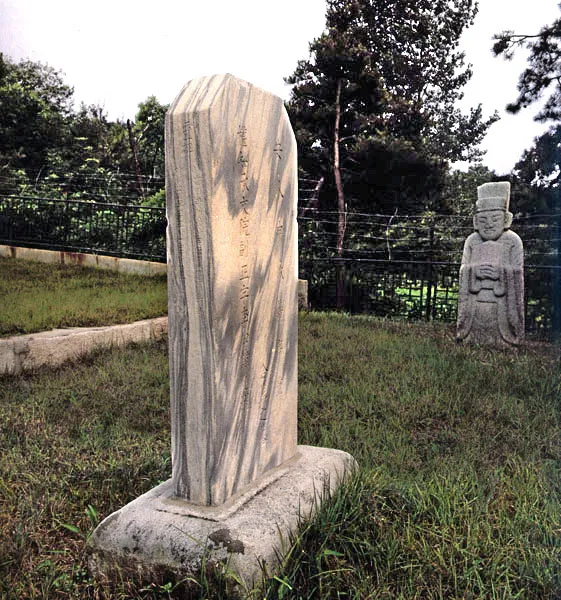
Iyuntak Hangeuryeongbi, Seoul
서울 李允濯 한글靈碑
서울특별시 노원구
Basic information
- Designation
- Treasure No.1524
- Category
- Books & Records
- Era
- 조선시대(중종31년(1536년))
- Designated year
- 2007
- Location
- 노원구, 서울특별시— 서울 노원구 하계1동 12번지
- Coordinates
- 37.645436, 127.076754
AI Docent
Coming soonAn AI-generated, friendly retelling of this heritage site is available in Korean. An English version is on our roadmap — for now, please see the official description below.
Description
This is the oldest known tomb stone carrying an inscription in Hangeul (Korean alphabet). It was erected in 1536 by Yi Mun-geon in front of his parents' tomb after interring the remains of his father, Yi Yun-tak, and his mother, Lady Sin from Goryeong, who had been buried in separate graves. The tomb stone is inscribed with the names of the buried couple and their profiles on the front and the back. The sides have warnings against doing damage to the tomb. Particularly notable is the warning in Hangeul inscribed on the left side of the tomb stone, which is known to be the oldest tomb tone inscription written in Hangeul. The tomb stone is important for several reasons. First, it suggests how widely Hangeul was used around 1536. Second, Hangeul carved on the tomb stone represents transition from the initial style as printed in Hunminjeongeum haerye (Explanations and Examples of the Proper Sounds for the Instruction of the People) in 1446 and that in Yongbieocheonga (Song of Dragons Flying in Heaven), which was compiled to experiment the poetic use of the newly invented script and published in 1447. Third, the text for the inscription was written in pure Korean, a remarkable fact considering that the earliest known document written in pure Korean appeared in the 18th century. Fourth, the text was not translated from original Chinese but was written in pure Korean from the beginning. Though a simple short sentence, it deserves attention because most Korean texts at the time were translations from originals written in Chinese characters. It testifies that Hangeul had become a tool for written communication, not just for translation from writings originally in Chinese characters. Fifth, the Korean inscription on this tomb stone is helpful for understanding the Korean language spoken at the time.
Location
지도를 불러오는 중…
Have you visited this place?
Log in and verify your visit on-site via GPS to record a stamp in My Journey. (QR verification coming later.)
Images: KOGL (khs.go.kr) · Data source: Korea Heritage Service Open API (khs.go.kr)