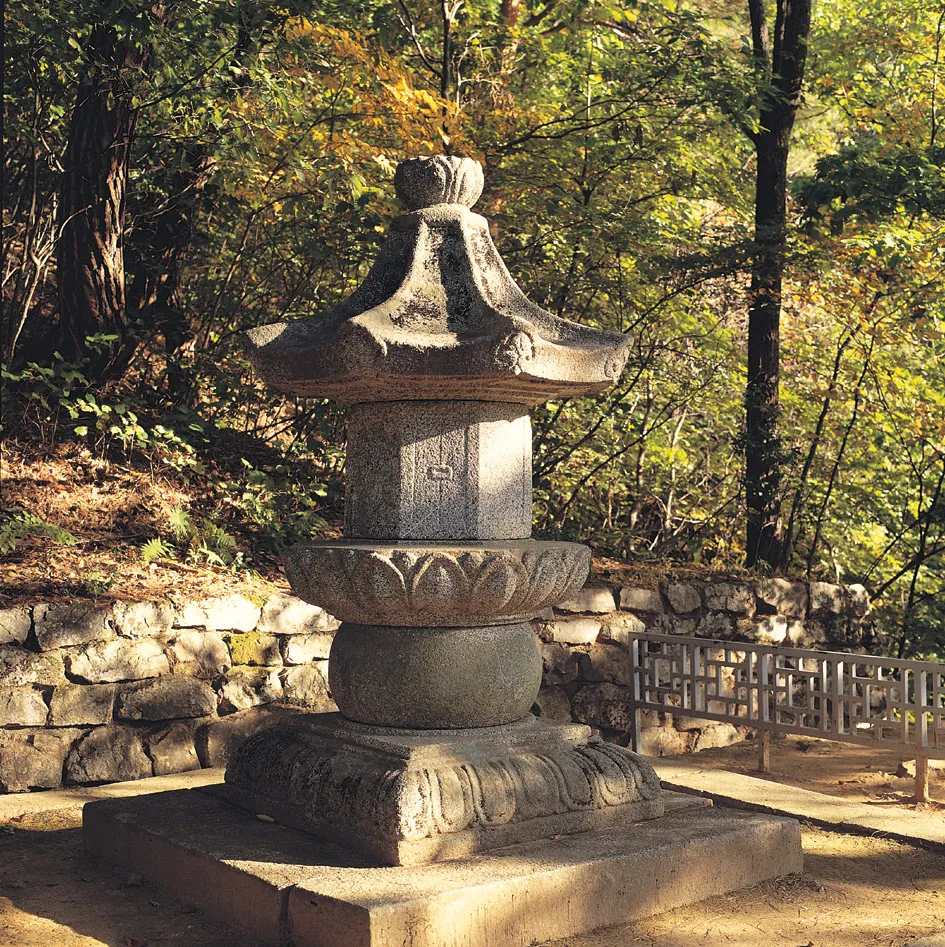
Stupa and Stele of State Preceptor Jeongji at Yongmunsa Temple, Yangpyeong
楊平 龍門寺 正智國師塔 및 碑
경기도 양평군
Basic information
- Designation
- Treasure No.531
- Category
- Sites & Pagodas
- Era
- 조선시대 초기
- Designated year
- 1971
- Location
- 양평군, 경기도— 경기 양평군 용문면 신점리 산99-6번지 용문사
- Coordinates
- 37.550932, 127.573498
AI Docent
Coming soonAn AI-generated, friendly retelling of this heritage site is available in Korean. An English version is on our roadmap — for now, please see the official description below.
Description
These stupa and stele, which have the records of State Preceptor Jeongji (1324-1395), are located 300m east of Youngmunsa Temple. State Preceptor Jeongji, a Buddhist monk of the late Goryeo period, was born in Jaeryeong, Hwanghae Province and educated in Yanjing, China. He entered Nirvana during the 4th year of the reign of King Taejo. With a shining sarira found in great quantities after his death, King Taejo named him State Preceptor Jeongji. The stupa and stele stand about 80m apart. The stupa, which was erected by Joan and others, looks octagonal with its square stylobate and lower pedestal as well as its octagonal upper pedestal and main body. Its upper and lower pedestals are carved with lotus; its drum-shaped, middle pedestal only has a graceful curve without any decoration. Meanwhile, the main body is engraved with a perfunctory door on one of its sides. The roof stone has three-tier cornices, and the eaves have a rafter engraved on each of its corners. The roof stone has large, clearly visible octagonal rooflines; at its end is a flower decoration that is not as sophisticated as the former shape. Meanwhile, the stupa has a lotus-shaped decoration at its top. The small stone stele has sides carved to look as if they were folded. It also has thin lines engraved around characters. Its epitaph was written by Gwon Geun, a famous scholar of that era. At first, it was erected on a natural rock located 20m under the Stupa of State Preceptor Jeongji, but it fell from the rock and got neglected. Therefore, it was erected again in today’s place around 1970.
Location
지도를 불러오는 중…
Have you visited this place?
Log in and verify your visit on-site via GPS to record a stamp in My Journey. (QR verification coming later.)
Images: KOGL (khs.go.kr) · Data source: Korea Heritage Service Open API (khs.go.kr)