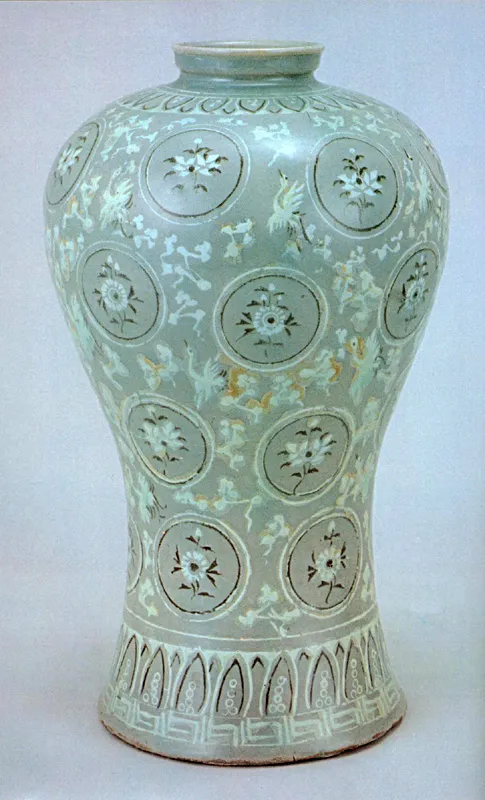
Celadon Prunus Vase with Inlaid Cloud, Crane, Peony, and Chrysanthemum Design
靑磁 象嵌雲鶴牡丹菊花文 梅甁
서울특별시 용산구
Basic information
- Designation
- Treasure No.558
- Category
- Craft
- Era
- 고려시대(12세기 중엽)
- Designated year
- 1971
- Location
- 용산구, 서울특별시— 서울 용산구 이태원로55길 60-16, 삼성미술관 리움 (한남동)
- Coordinates
- 37.536528, 126.996187
AI Docent
Coming soonAn AI-generated, friendly retelling of this heritage site is available in Korean. An English version is on our roadmap — for now, please see the official description below.
Description
Inlaid celadon vases are made by incising a pattern or an image on the surface of a vase and filling the incised areas with white clay or China clay. After inlaying the motifs, the vase is glazed and fired, and the motifs usually appear white or black through the transparent celadon glaze. The technique of celadon inlaying was developed in the early 12th century and reached its high point in the mid-12th century. This inlaid celadon prunus vase stands 32.2㎝ tall with the mouth and the bottom measuring 7㎝ and 14.5cm, respectively, in diameter. Compared to a typical Goryeo prunus vase, this item has more sloping shoulders for a softer silhouette. The wide base conveys a greater feeling of stability as well. The glaze, evenly distributed across the surface, is sheer and has a beautiful hue. The small mouth is slightly turned outward at the edge. The shoulders are bedecked with inlaid lotus flowers. A series of lightning motifs surround the vase at its base with lotus design placed above them. The surface on the body of the vase is decorated with round circles in black and white clays, and each of them enclose a peony blossom, accompanied by a chrysanthemum flower on stem. This celadon vase is dated to sometime in the mid-12th century.
Location
지도를 불러오는 중…
Have you visited this place?
Log in and verify your visit on-site via GPS to record a stamp in My Journey. (QR verification coming later.)
Images: KOGL (khs.go.kr) · Data source: Korea Heritage Service Open API (khs.go.kr)