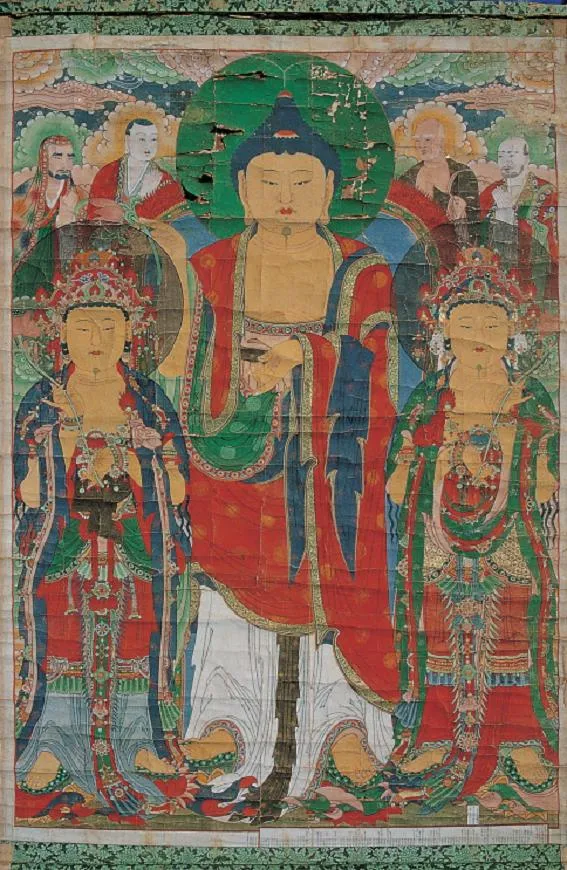
Seonseoksa Yeongsanhoe Hanging Buddhist Painting (Gwaebultaeng), Seongju
星州 禪石寺 靈山會 掛佛幀
경상북도 성주군
Basic information
- Designation
- Treasure No.1608
- Category
- Painting
- Designated year
- 2009
- Location
- 성주군, 경상북도— 경북 성주군 월항면 세종대왕자태실로 616-33, 선석사 (인촌리)
- Coordinates
- 36.015654, 128.298926
AI Docent
Coming soonAn AI-generated, friendly retelling of this heritage site is available in Korean. An English version is on our roadmap — for now, please see the official description below.
Description
This Buddhist painting was painted in 1702 (the 28th year of King Sukjong’s reign) by four monk painters, including Takhwi, Beophae, Seoljam and Seongjing. Sakyamuni Buddha in the center, portrayed larger than the rest of figures, is escorted by two attendant Bodhisattvas, Manjusri and Samantabhadra Bodhisattva, standing to his left and right. In the top tier of the Buddhist painting, Ananda and Mahakasyapa, along with two other disciples of Buddha, are portrayed down to the waist, with their hands gathered in a gesture of reverence. The left and right attendant Bodhisattvas are portrayed in a slightly more forward position than Sakyamuni, so that their bodies are overlapped, in a manner to emphasize the spatial depth. Sakyamuni Buddha’s hands, meanwhile, are not in the usual position of bhumisparsa or vitarka mudra. Instead, his left hand is lifted to the shoulder level, holding a lotus stem. The note on the back of the Buddhist painting means “one copy of the Vulture Peak Assembly scene enshrined,” suggesting that this painting symbolically expresses the Zen Buddhist idea of the truth that is beyond verbal explanation and the unity of Zen and non-Zen Buddhism, popular during the Joseon Dynasty. Notably, this Buddhist painting is the oldest surviving Buddhist painting hinting at the idea of the truth beyond verbal explanation. As an early Buddhist painting on the theme of the Vulture Peak Assembly, this work is also of great significance for the study of Buddhist iconography; it is a pioneering work introducing the novel iconography of Sakyamuni holding a lotus stem, and had served as the model for the Hanging Painting of Yongmunsa Temple, Yecheon (1709, Treasure No. 1445). Meanwhile, the magnificent combination of colors and sophisticated brushwork make this work a flattering example of early 18th-century Joseon Buddhist paintings.
Location
지도를 불러오는 중…
Have you visited this place?
Log in and verify your visit on-site via GPS to record a stamp in My Journey. (QR verification coming later.)
Images: KOGL (khs.go.kr) · Data source: Korea Heritage Service Open API (khs.go.kr)