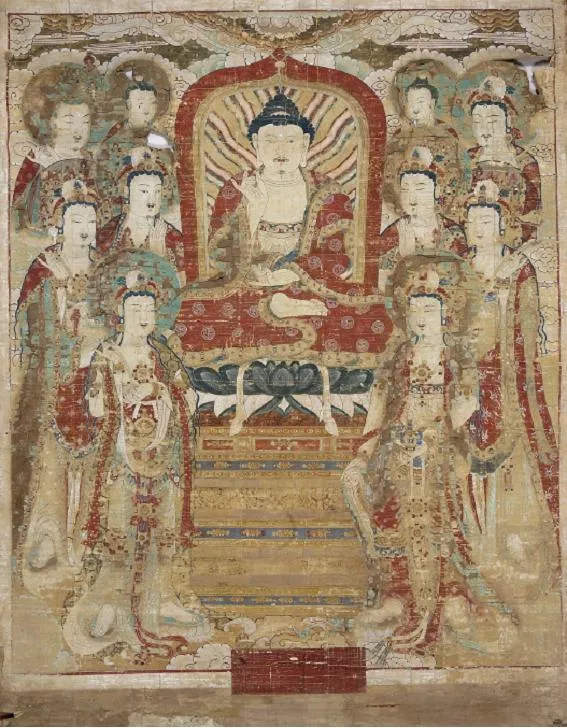
Donghwasa Amitahoesangdo, Daegu
大邱 桐華寺 阿彌陀會上圖
대구광역시 동구
Basic information
- Designation
- Treasure No.1610
- Category
- Painting
- Era
- 17세기 후반
- Designated year
- 2009
- Location
- 동구, 대구광역시— 대구광역시 동구 동화사1길 1 (도학동)
- Coordinates
- 35.993304, 128.703690
AI Docent
Coming soonAn AI-generated, friendly retelling of this heritage site is available in Korean. An English version is on our roadmap — for now, please see the official description below.
Description
This Buddhist painting, representing Amitabha Buddha accompanied by a Buddhist pantheon, was painted in 1699 (the 25th year of King Sukjong’s reign) by a group of painters including Uigyun, Myohae, Jiyeong and Sangmyeong. The painting consists of three panels, with Amitabha Buddha portrayed in one, and Bodhisattvas and Divine Guardians of the Dharma portrayed in two others. All three panels have frayed edges and are torn off in parts with paint peeled off from various areas. In spite of the poor state of preservation, the painting is, nevertheless, remarkable for the faces of the figures, drawn in thin lines, conveying a strong sensation of volume, detailed depiction of facial expressions, well-proportioned bodies and subtle light-toned colors, in a fine display of Uigyun’s experienced brushwork and unique flair for colors. This painting also stands out for its composition in which, unlike other paintings of Amitabha where all attendant Bodhisattvas, Arhats and Divine Guardians of the Dharma are grouped together in one panel, the eight Bodhisattvas are portrayed in the left panel, and Arhats, Brahma and Indra and Divine Guardians of the Dharma are separately placed in the right panel, in a manner to distinguish the scene of Amitabha Buddha’s sermon from the pantheon of Bodhisattvas and guardians of Buddhism. As the oldest surviving work of Uigyun, a major Buddhist painter based in the Palgongsan Mountain area, active between the late 17th century and the early 18th century, this painting has an immeasurable value, casting light on his early style.
Location
지도를 불러오는 중…
Have you visited this place?
Log in and verify your visit on-site via GPS to record a stamp in My Journey. (QR verification coming later.)
Images: KOGL (khs.go.kr) · Data source: Korea Heritage Service Open API (khs.go.kr)