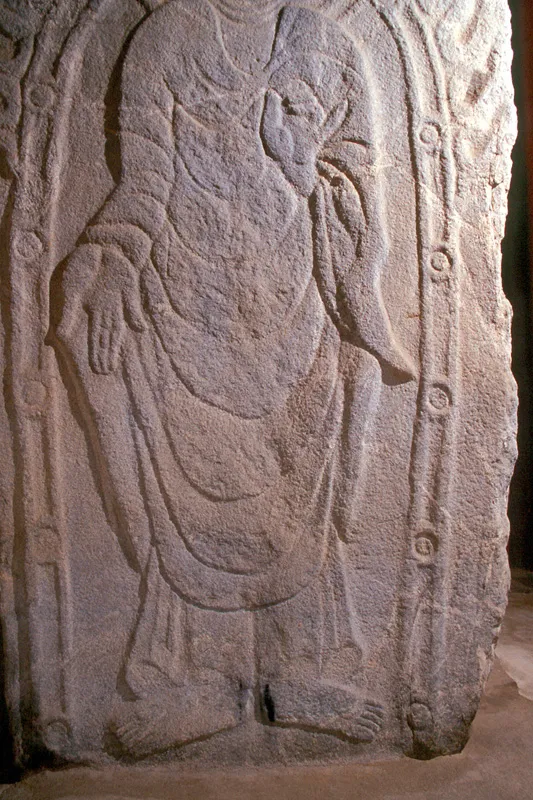
Stone Standing Buddha in Jangjeong-ri, Ganghwa
江華 長井里 石造如來立像
인천광역시 강화군
Basic information
- Designation
- Treasure No.615
- Category
- Sculpture
- Era
- 고려시대
- Designated year
- 1978
- Location
- 강화군, 인천광역시— 인천 강화군 하점면 장정리 584번지
- Coordinates
- 37.781265, 126.424437
AI Docent
Coming soonAn AI-generated, friendly retelling of this heritage site is available in Korean. An English version is on our roadmap — for now, please see the official description below.
Description
This Goryeo-period stone Buddha is located at the foot of Bongcheonsan Mountain at Hajeom-myeon, Ganghwa-gun, Incheon. The bas-relief Buddha is realized on a thick granite slab and is currently placed inside an open pavilion that was specially built to shelter it. The Buddha figure has a small ushnisha at the top center of the head and a plump face that is oblong in shape. The facial features including the eyes, nose and the mouth are a bit squat and thick. The ears are unrealistically long, and the neck is so short that the three lines on it extend almost to the chest. The robe enveloping both of the two shoulders is thick with no body lines appearing through it. The narrow, rounded shoulders make this Buddha appear slightly huddled. Garment folds, shaped like the letter ‘U,’ begin at the chest level, continuing down to the knees. The drapery is rendered overall quite cursorily. The right hand held down to the level below the waistline has its palm turned outward. The left hand is held up at the chest level with fingers bent. The mandorla is outlined by two thick embossed lines, and the nimbus around the head is separate from the aureola around the body. Round bead-like motifs are placed between the two lines, at regular intervals. The mandorla has flamed edges. This bas-relief Buddha is two-dimensional and lacks depth, with a strong tendency toward simplified treatment of details. Meanwhile, such elements the face projecting a good sense of volume, short neck, huddled shoulders and the cursorily-rendered drapery make it a typical Goryeo-period Buddhist sculpture.
Location
지도를 불러오는 중…
Have you visited this place?
Log in and verify your visit on-site via GPS to record a stamp in My Journey. (QR verification coming later.)
Images: KOGL (khs.go.kr) · Data source: Korea Heritage Service Open API (khs.go.kr)