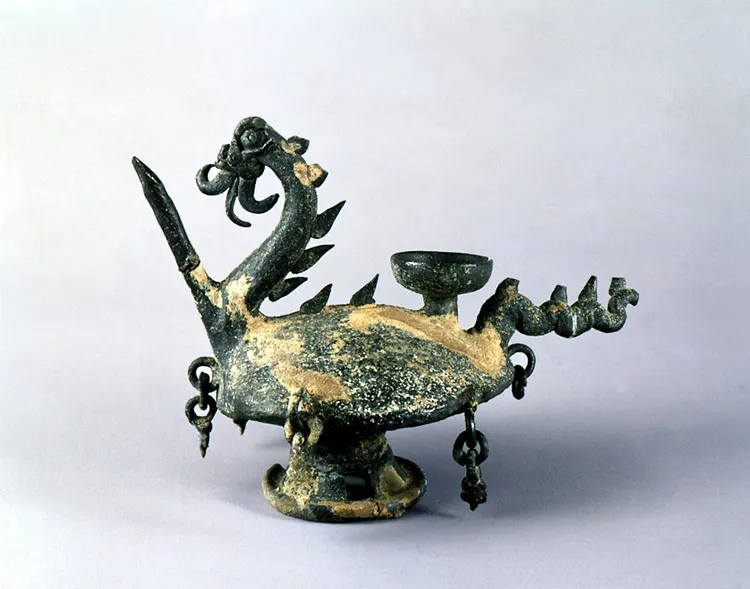
Stoneware Seosuhyeong Myeonggi
陶器 瑞獸形 明器
경상북도 경주시
Basic information
- Designation
- Treasure No.636
- Category
- Craft
- Era
- 신라시대(5∼6세기)
- Designated year
- 1978
- Location
- 경주시, 경상북도— 경상북도 경주시 일정로 186 (인왕동, 국립경주박물관)
- Coordinates
- 35.829387, 129.227912
AI Docent
Coming soonAn AI-generated, friendly retelling of this heritage site is available in Korean. An English version is on our roadmap — for now, please see the official description below.
Description
This is earthenware with an eye-catching shape, dug out from the Old Tomb No. 3 in Section C of an ancient burial mound located in front of the Tomb of King Michu in Gyeongju. The turtle-shaped piece is 15.1 cm tall and 17.5 cm long with a base 5.5 cm long in diameter. It has a head and a tail shaped like those of a dragon, and its trumpet-shaped base has a square hole. There are two sharp horns on its spine and dangling ornaments, one each on the front and back and two each on the left and right side of the body. The S-shaped head is held high, and on the back of the neck are five horns similar to those found on the back. The eyes are open wide. Both lips are rolled outward and the tongue is stuck out very far. The tail is shaped like a wave, forming a T-shape with its horned end reaching out far horizontally. A long spout hangs down from the chest, and a rice bowl-shaped bowl is attached to the rear end. Although it has a dark gray surface and looks similar to other animal-shaped earthenware from the Goryeo Dynasty, it still shows a very fresh conception. There is an interesting story about the Tomb of King Michu. King Michu (? ~ A.D. 284), the thirteenth monarch of Silla, died 23 years after he was crowned. When Geumseong (the present-day city of Gyeongju), the capital of Silla, was attacked by Iseogoguk (a tribal nation to the west of Silla) during the reign of his son King Yuri, a host of soldiers with bamboo leaves stuck behind their ears suddenly appeared from nowhere and helped the Silla army to defeat the invaders. Having searched the place where these soldiers had disappeared after the battle, the Silla soldiers only found a pile of bamboo leaves lying in front of King Michu's tomb. King Yuri then realized that it was a pious act of his late father that had helped him save his kingdom. The king named the tomb Jukhyeonneung, or the Tomb where Bamboo Leaves Appeared.
Location
지도를 불러오는 중…
Have you visited this place?
Log in and verify your visit on-site via GPS to record a stamp in My Journey. (QR verification coming later.)
Images: KOGL (khs.go.kr) · Data source: Korea Heritage Service Open API (khs.go.kr)