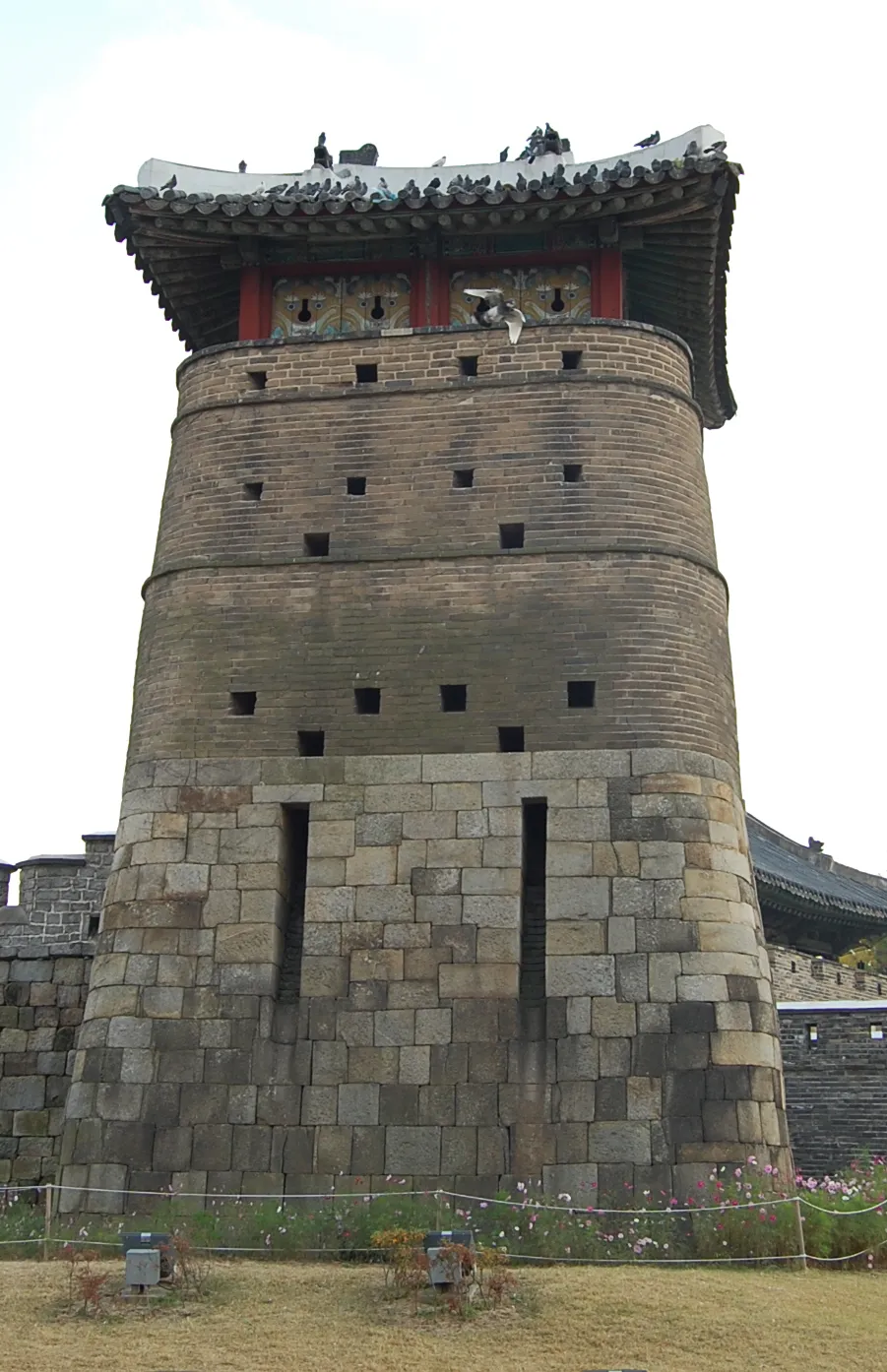
Seobukgongsimdon, Suwon
水原 西北空心墩
경기도 수원시
Basic information
- Designation
- Treasure No.1710
- Category
- Architecture
- Era
- 조선시대
- Designated year
- 2011
- Location
- 수원시, 경기도— 경기 수원시 팔달구 장안동 332번지
- Coordinates
- 37.285820, 127.009550
AI Docent
Coming soonAn AI-generated, friendly retelling of this heritage site is available in Korean. An English version is on our roadmap — for now, please see the official description below.
Description
This watchtower is located next to the Hwaseomun Gate of Hwaseong Fortress and was built in 1796 (the 20th year of King Jeongjo’s reign). This turret-style watchtower on the northeast side of the fortress, juts out from the fortified wall in a manner to provide a good view into all directions. The structure is divided into three tiers. The base is built with square stone blocks, and the outer walls of the first and second floors and the lower section of the third floors are constructed with bricks. There are six casemates on each of the three walls at the first and second floors, and a battlement at the third floor, along with four casemates positioned at the same height as the battlement. The sentry post at the third floor, measuring about two kan (the space between two columns, one kan being about 2.5m) on the front and side, is surmounted by a hipped-and-gabled roof. The wooden doors above the wall also have a series of gun holes. On the north and west walls of the turret, there are two loopholes to thwart the enemy approaching the fortress. The lower section has stone blocks trimmed into the shape of the letter ‘U’ in a manner to interlock with the brick casemates above them. The Northwestern Watchtower of Hwaseong Fortress, built in a style which has never been seen in any other surviving fortresses, is remarkable for the flexibility and functionality of materials used as well as for the quality of construction, in both stone and brick structures, especially impressively displayed in details like casemates and loopholes. This watchtower is as magnificent as it is original as a piece of architecture.
Location
지도를 불러오는 중…
Have you visited this place?
Log in and verify your visit on-site via GPS to record a stamp in My Journey. (QR verification coming later.)
Images: KOGL (khs.go.kr) · Data source: Korea Heritage Service Open API (khs.go.kr)