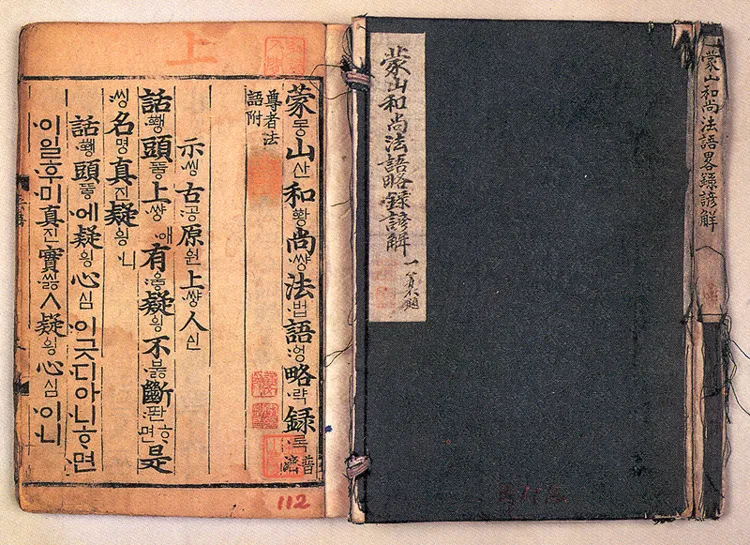
Mongsanhwasangbeobeoyakrok(eonhae)(1984-2)
蒙山和尙法語略綠(諺解)(1984-2)
서울특별시 서초구
Basic information
- Designation
- Treasure No.767-2
- Category
- Books & Records
- Era
- 조선성종 3년(1472)
- Designated year
- 1984
- Location
- 서초구, 서울특별시— 서울특별시 서초구
- Coordinates
- 37.483589, 127.032735
AI Docent
Coming soonAn AI-generated, friendly retelling of this heritage site is available in Korean. An English version is on our roadmap — for now, please see the official description below.
Description
Mongsanhwasang beobeo yangnok (Sermons of Buddhist Monk Mongsan with Commentaries in Korean) is a compilation of Buddha’s teachings, providing guidance to monks in their spiritual development. This book was widely read in Korea during the Joseon Dynasty. The book contains a selection of Buddhist teachings chosen specifically for Goryeo monks by Mongsan (Ch. Mengshan Deyi), a famous monk of the Yuan Dynasty, along with his own sermons. This particular version was translated into Hangeul and was annotated by Sinmi of Joseon. The book, printed with wood blocks on mulberry paper, is 17.1cm by 26.5cm in dimension. Mengshan Deyi actively exchanged with Goryeo monks, maintaining particularly close ties with State Preceptors Hyegam and Bogam. Mengshan Deyi had a profound influence on Korean Buddhism, and Liuzu tanjing (Platform Sutra of the Sixth Patriarch) edited by him and his sermons had the largest circulation in Korea among works by a Chinese monk. Although the exact year of publication is unknown, given that a series of sermons translated into Hangeul by Sinmi is included in Moguja susimgyeol (Golden Teachings on Mind Cultivation),’ published in 1467 (the 13th year of King Sejo’s reign), this book probably dates from around the same time. As a Hangeul-translated Buddhist publication from early Joseon, this book is invaluable for research into the history of Korean Buddhism as well as the early Hunminjeongeum (The Proper Sounds for the Instruction of the People).
Location
지도를 불러오는 중…
Have you visited this place?
Log in and verify your visit on-site via GPS to record a stamp in My Journey. (QR verification coming later.)
Images: KOGL (khs.go.kr) · Data source: Korea Heritage Service Open API (khs.go.kr)