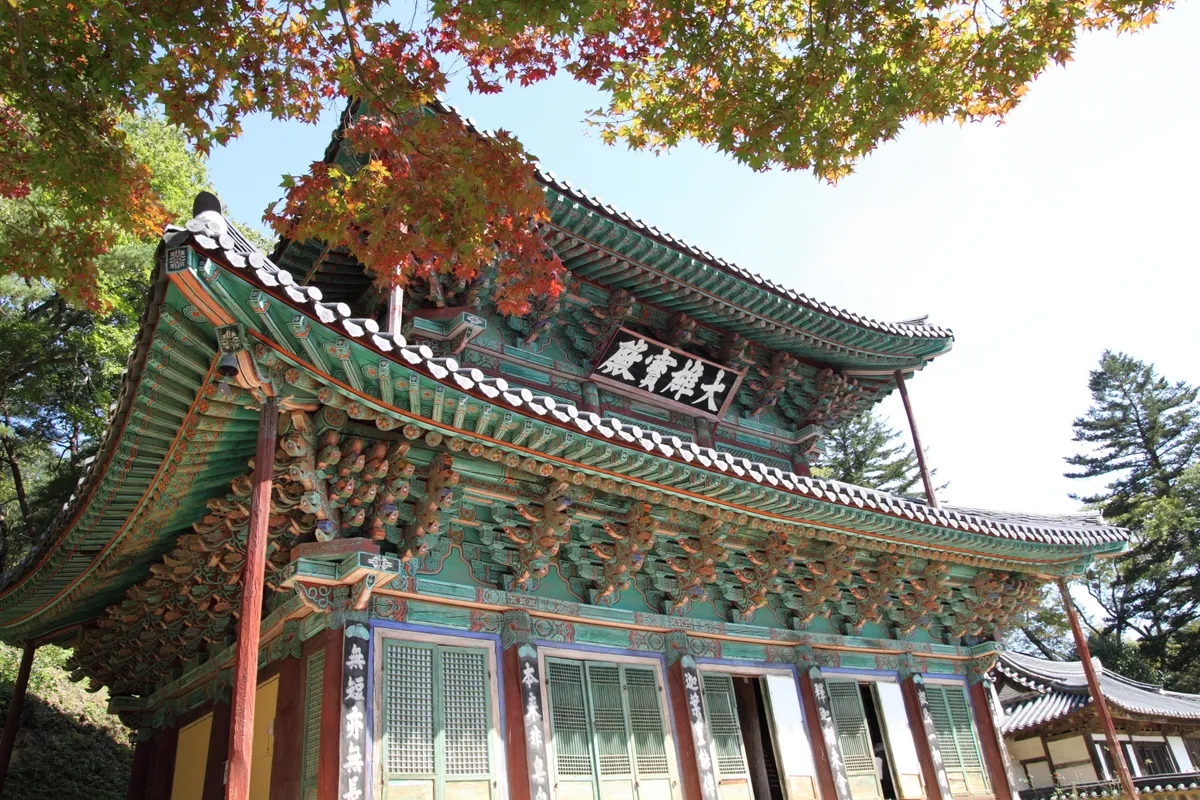
Daeungbojeon Hall of Magoksa Temple, Gongju
公州 麻谷寺 大雄寶殿
충청남도 공주시
Basic information
- Designation
- Treasure No.801
- Category
- Architecture
- Era
- 백제 의자왕 2년(643)
- Designated year
- 1984
- Location
- 공주시, 충청남도— 충남 공주시 사곡면 마곡사로 966, 마곡사 (운암리)
- Coordinates
- 36.559483, 127.012125
AI Docent
✨ AI-generated# Daeungbojeon Hall of Magoksa Temple Welcome to one of Korea's most architecturally remarkable Buddhist halls! Magoksa Temple itself has a fascinating history—scholars debate whether Buddhist monks founded it in the 640s, but what we know for certain is that after being rebuilt in 1651, this temple became a masterpiece of Joseon craftsmanship. The Daeungbojeon Hall you're standing before is extraordinary: a two-story structure that enshrines four Buddha statues, including the main Sakyamuni Buddha. Look up and notice the elegant hip-and-gable roof and the intricate wooden support system—the gongpo brackets extend not just from pillars but between them, creating what's called the dapo style. Admire the lotus flower patterns carved on the outside—hallmarks of mid-to-late Joseon decoration. Here's something special: calligraphy by Kim Saeng, a master from ancient Silla, graces the second-floor hanging board. This building tells the story of Korean Buddhist architecture like few others can.
⚠ This is an AI-generated retelling of the official description. For accuracy, refer to the official description below.
Description
Opinion is divided on the foundation of Magoksa Temple. Some say it was built by Buddhist Monk Jajang Yulsa in 640, the ninth year of the reign of Queen Seondeok of Silla, while others say Buddhist Monk Museon of Silla built it after returning from Tang China. It was closed from late Silla to the early days of Goryeo but was rebuilt by State Preceptor Bojo in 1172, the second year of the reign of King Myeongjong of Goryeo. It then remained dilapidated again for 60 years following the Japanese Invasion of Korea in 1592. The Buddhist Monk Gaksun rebuilt Daeungjeon Hall, Yeongsanjeon Hall and Daejeokgwangjeon Hall in 1651, the second year of the reign of King Hyojong of Joseon. Daeungbojeon Hall is the sanctum enshrining a Sakyamuni statue and it also enshrines Bhaisajyaguru Buddha, Amitabha Buddha and Sakyamuni Buddha as the main statue. The hall was rebuilt by the Buddhist Monk Gaksun along with the temple in 1651. It is composed of 5-kan (a unit of measurement referring to the distance between two columns) front space and 4-kan side space in the first floor and 3-kan front space and 3-kan side space in the second floor. It has a hip and gable roof called paljakjibung. The gongpo that holds up the roof eaves on the pillars is set up not only on the pillars but also between them. This building style is known as dapo style. A lotus flower pattern is engraved on the outside extensions, showing the typical decoration style of mid and late Joseon. Kim Saeng, a master of calligraphy in Silla inscribed the calligraphy on the hanging board on the second floor. A decoration with the pattern of the Chinese character 井 (jeong) serves to conceal the ceiling and is connected to a beam on the second floor. The floor is wide and magnificent. The hall is regarded as an important cultural asset, and with its unique structure as a two-story building, an important source for studying the architectural history of mid Joseon.
Location
지도를 불러오는 중…
Have you visited this place?
Log in and verify your visit on-site via GPS to record a stamp in My Journey. (QR verification coming later.)
Images: KOGL (khs.go.kr) · Data source: Korea Heritage Service Open API (khs.go.kr)