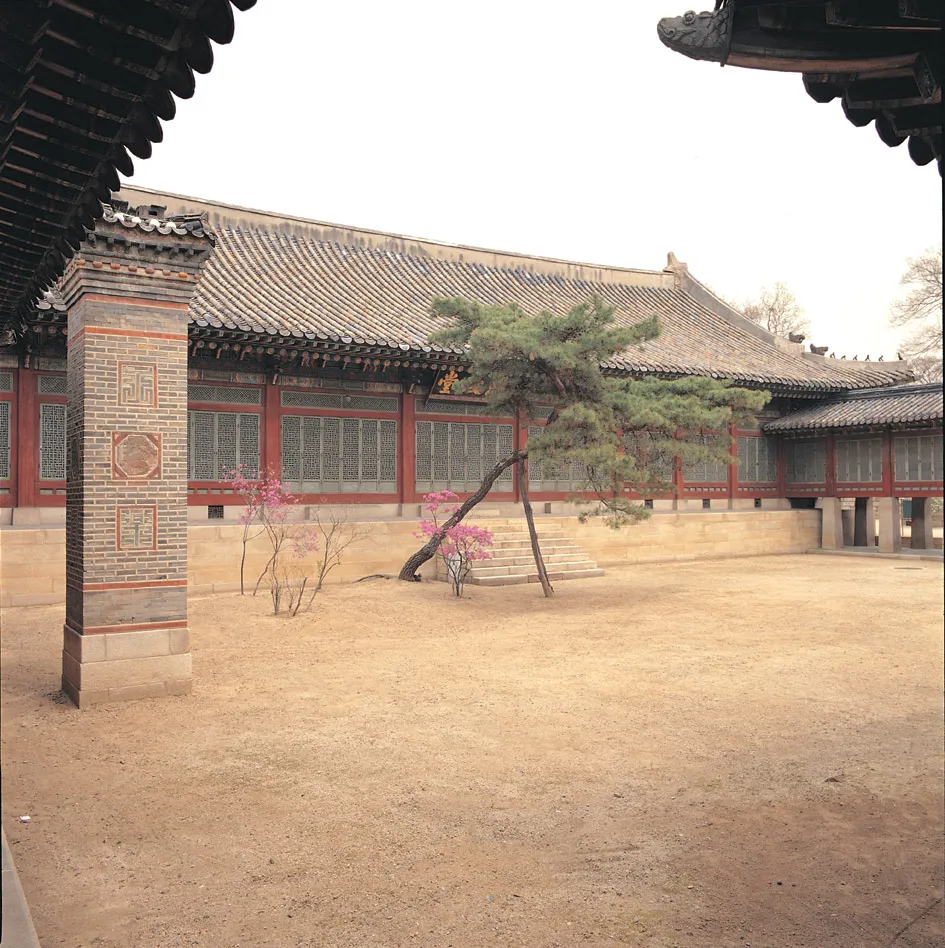
Changdeokgung Huijeong Hall
昌德宮 熙政堂
서울특별시 종로구
Basic information
- Designation
- Treasure No.815
- Category
- Architecture
- Era
- 조선 고종 4년(1867)
- Designated year
- 1985
- Location
- 종로구, 서울특별시— 서울 종로구 율곡로 99, 창덕궁 (와룡동)
- Coordinates
- 37.579557, 126.992224
AI Docent
Coming soonAn AI-generated, friendly retelling of this heritage site is available in Korean. An English version is on our roadmap — for now, please see the official description below.
Description
Huijeongdang was originally used as the king's sleeping quarters and was later used by the king as an office and reception hall. It is not clear when it was first built. In 1496, a palace building named Sumundang was destroyed, rebuilt, and renamed Huijeongdang. However, the building had gone through a series of destructions and reconstructions before it was burnt down for the last time in 1917. The present building was constructed in 1920 with the disassembled materials of Gangnyeongjeon Hall of Gyeongbokgung Palace. Huijeongdang Hall, composed of 11-kan (a unit of measurement referring to the distance between two columns) front space and 4-kan side space, retains a traditional Korean exterior to a great extent, but the interior is westernized. It has a hip and gable roof called paljakjibung. Of the 9-kan front space, 3-kan space in the center was used as a drawing room, the same size space in the west as a conference room, and the space in the east was divided into smaller rooms. The remaining space of the building was used as corridors. On the walls of the drawing room in which the king received foreign envoys are hanging Chongseokjeong jeolgyeongdo (Superb Landscape of Chongseokjeong Pavilion) and Geumgangsan manmul choseunggyeongdo (Picturesque Landscape of the Myriad Things on Geumgangsan Mountain) painted by Kim Gyu-jin. With the influx of western civilization, a curved entrance was added to the building to provide easy access for the king's automobiles. Huijeongdang Hall is thus a representative example of acculturation.
Location
지도를 불러오는 중…
Have you visited this place?
Log in and verify your visit on-site via GPS to record a stamp in My Journey. (QR verification coming later.)
Images: KOGL (khs.go.kr) · Data source: Korea Heritage Service Open API (khs.go.kr)