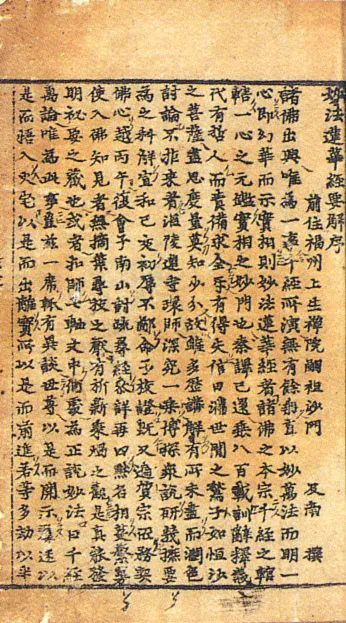
Myobeobyeonhwagyeong(1988)
妙法蓮華經(1988)
충청북도 단양군
Basic information
- Designation
- Treasure No.960
- Category
- Books & Records
- Era
- 1382년(고려 우왕8년)
- Designated year
- 1988
- Location
- 단양군, 충청북도— 충청북도 단양군 백자길 9 (영춘면, 불교천태중앙박물관)
- Coordinates
- 37.043564, 128.485169Kakao address conversion
AI Docent
Coming soonAn AI-generated, friendly retelling of this heritage site is available in Korean. An English version is on our roadmap — for now, please see the official description below.
Description
The Lotus Sutra, or Saddharma Pundarika Sutra in Sanskrit, is one of the most popular Mahayana sutras whose main teaching is that anyone can attain Buddhahood. It is a foundational text of the Cheontae (or Tiantai in Chinese) School which has been one of the two schools, the other being Hwaeom (Huayuan) School, that had the greatest influence upon the development of Korean Buddhism. This sutra, originally interpreted by a Song monk Jiehuan, is consisted of two volumes of which the first volume, Books 1 to 3, is 15.2 centimeters long and 23.9 centimeters wide, and the second volume, Books 4 to 7, 16.5 centimeters long and 27.4 centimeters wide. According to the postscript written by Yi Saek (1328-1396) at the end of the book, the Lotus Sutra published by Jiehuan of the Chinese Song Dynasty had too large scripts so a Goryeo monk Jiseon rewrote it in small scripts. The publication of the Goryeo edition took place in 1382 under the auspices of devoted Buddhist followers including Prince Suyeon (or Wang Gyu). The first volume (Books 1 to 3) was printed with the original woodblocks during the early Joseon Period (1392-1910) and the second volume (Books 4 to 7) at a later time.
Location
지도를 불러오는 중…
Have you visited this place?
Log in and verify your visit on-site via GPS to record a stamp in My Journey. (QR verification coming later.)
Images: KOGL (khs.go.kr) · Data source: Korea Heritage Service Open API (khs.go.kr)