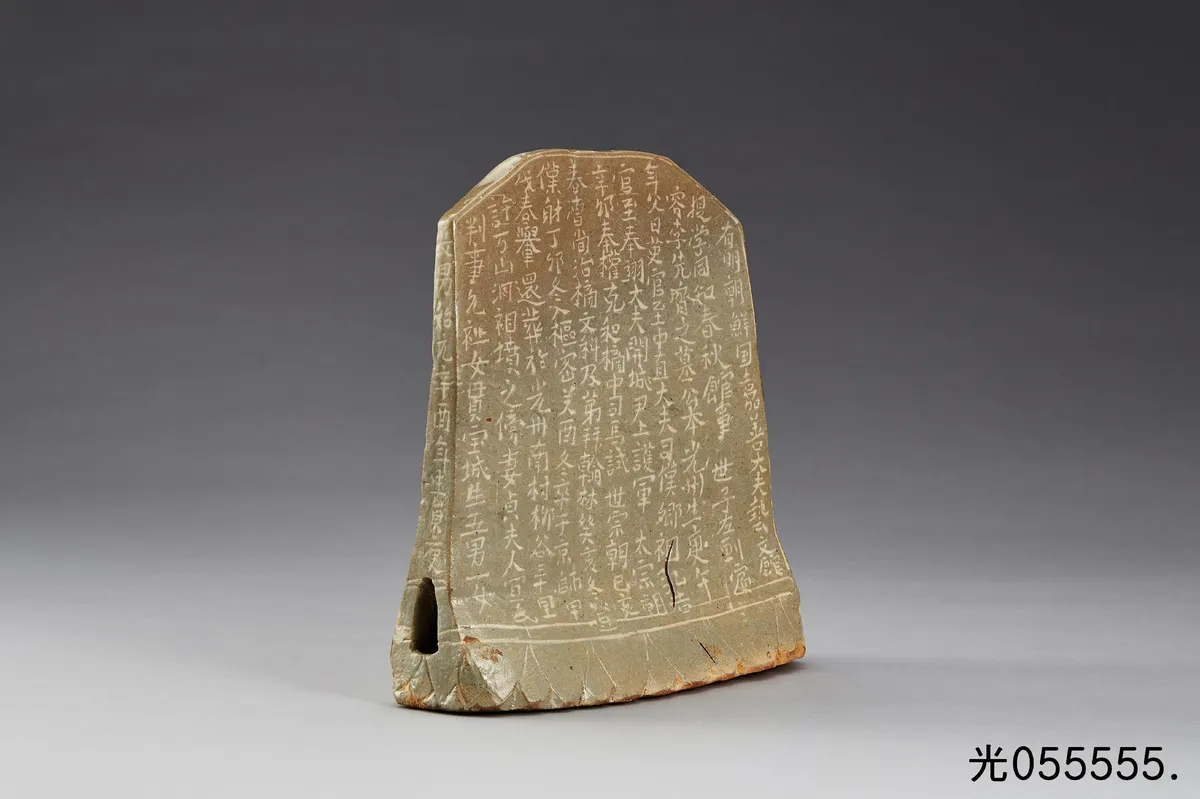
Buncheong Ware Sanggam ‘gyeongtae5nyeonmyeong’ Iseonje Myoji
粉靑沙器 象嵌 ‘景泰五年銘’ 李先齊 墓誌
광주광역시 북구
Basic information
- Designation
- Treasure No.1993
- Category
- Craft
- Era
- 1454년(단종 2)
- Designated year
- 2018
- Location
- 북구, 광주광역시— 광주광역시 북구 하서로 110 (매곡동, 국립광주박물관)
- Coordinates
- 35.189657, 126.883951Kakao address conversion
AI Docent
Coming soonAn AI-generated, friendly retelling of this heritage site is available in Korean. An English version is on our roadmap — for now, please see the official description below.
Description
The Buncheong Memorial Tablet of Yi Seon-je with Inlaid Inscription of the “Fifth Gyeongtae Year is an epitaph for Yi Seon-je (1390-1453), who served as a Grade 2 official at the Jiphyeonjeon (Hall of Worthies), a royal research institute originally established by King Sejong. The tablet was smuggled out of the country via Gimpo Airport in June 1998, and was returned to Korea in September 2017 by a Japanese donor. The memorial tablet was made before the funeral etiquette for civilians was fixed and distributed in the early Joseon period. It is shaped like an actual mortuary tablet, consisting of two rectangular clay tablets attached to each other back to back. At that time, epitaphs were made on porcelain plate in the shape of a mortuary tablet, large disc, or bell, with the characters incised in cobalt blue, underglaze iron, or depressed engraving, etc. From the late fifteenth century on, the royal family had white porcelain plate-shaped epitaphs made for deceased family members. This particular memorial tablet provides valuable information on the epitaphs of early Joseon, a transition period in terms of the production of epitaphs, materials used, ornamental design, shape, and so on. Yi’s descendants were involved in a rebellion in 1589 led by Jeong Yeorip, in which many people, including them, were arrested and killed. As such, little is known about his family, although this epitaph partially makes up for the lack of information. It is also regarded as valuable heritage from the academic and artistic perspectives as it provides clues about changes in the funeral etiquette, porcelain production skills, and calligraphic style of that time.
Location
지도를 불러오는 중…
Have you visited this place?
Log in and verify your visit on-site via GPS to record a stamp in My Journey. (QR verification coming later.)
Images: KOGL (khs.go.kr) · Data source: Korea Heritage Service Open API (khs.go.kr)