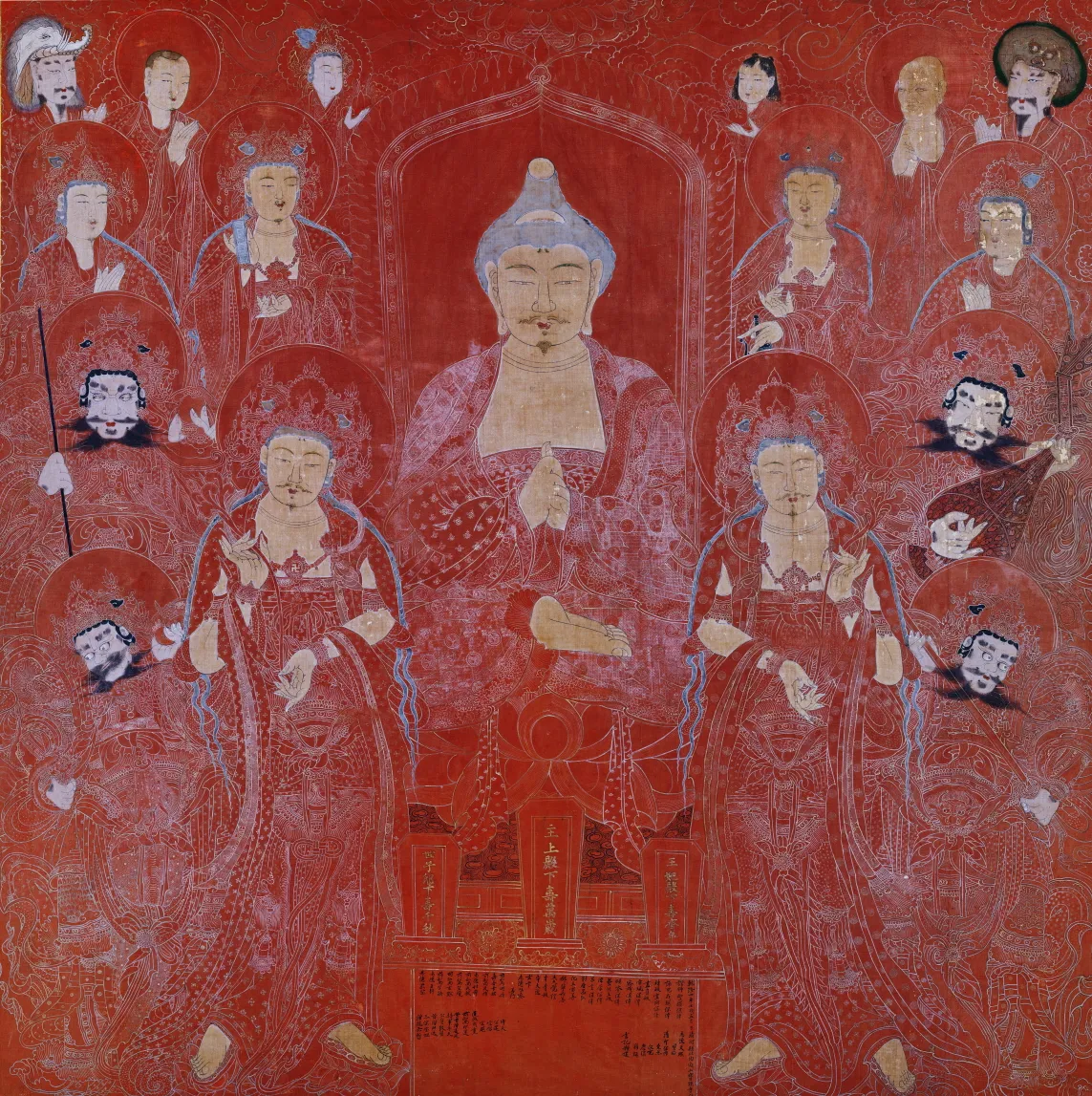
Bogyeongsa Birojanabuldo, Pohang
浦項 寶鏡寺 毘盧遮那佛圖
경상북도 포항시
Basic information
- Designation
- Treasure No.1996
- Category
- Painting
- Era
- 1742년(영조 18)
- Designated year
- 2018
- Location
- 포항시, 경상북도— 경상북도 포항시 북구 보경로 523 (송라면, 보경사)
- Coordinates
- 36.252968, 129.319200Kakao address conversion
AI Docent
Coming soonAn AI-generated, friendly retelling of this heritage site is available in Korean. An English version is on our roadmap — for now, please see the official description below.
Description
Vairocana Buddha of Bogyeongsa Temple in Pohang was created in 1742 by three monk-artists, Noehyeon, Milgi and Seokjam, who were active in the area around Gyeongsangbuk-do at the time, praying for the safety of the royal family of Joseon. The Buddhist deities in this painting are depicted using fine white lines against the background prepared by painting red pigment on a large hemp cloth, approx. 3 meters by 3 meters. The Buddhist painting made by applying gold lines onto a piece of silk appeared during the late Goryeo period but it was during Joseon in the 16th century that hemp began to be used for such altar painting following the spread of Buddhism to the common people. The tradition of painting Buddhist images on hemp continued in the 18th century, resulting in the creation of fine works such as this altarpiece. In this painting, the main subject, Vairocana Buddha, is suffounded by a group of his attendants and followers, including Samantabhadra (Bohyeon) and Manjsri (Munsu) Bodhisattvas, and the Four Heavenly Kings. As for the Buddhist altar paintings devoted to Vairocana Buddha, this painting is one of the earliest to have appeared in Korea. The harmony of the images captured with fine white lines on a red background, elaborate brushstrokes and nicely arranged decorative designs, good state of preservation, and clear knowledge of its production date and artitsts make the painting a valuable primary source for the study of Vairocana iconography and the line drawing of Buddhist altarpieces during late Joseon.
Location
지도를 불러오는 중…
Have you visited this place?
Log in and verify your visit on-site via GPS to record a stamp in My Journey. (QR verification coming later.)
Images: KOGL (khs.go.kr) · Data source: Korea Heritage Service Open API (khs.go.kr)